Who do you contact when you find a hole in the road? Why the same national road can have different contacts
Report a hole in the road to whoever manages that road: the city office for a municipal road, the national road office for a national road. If you don't know, tell #9910 by phone or LINE. Contacts by road type, and what to say when you report.
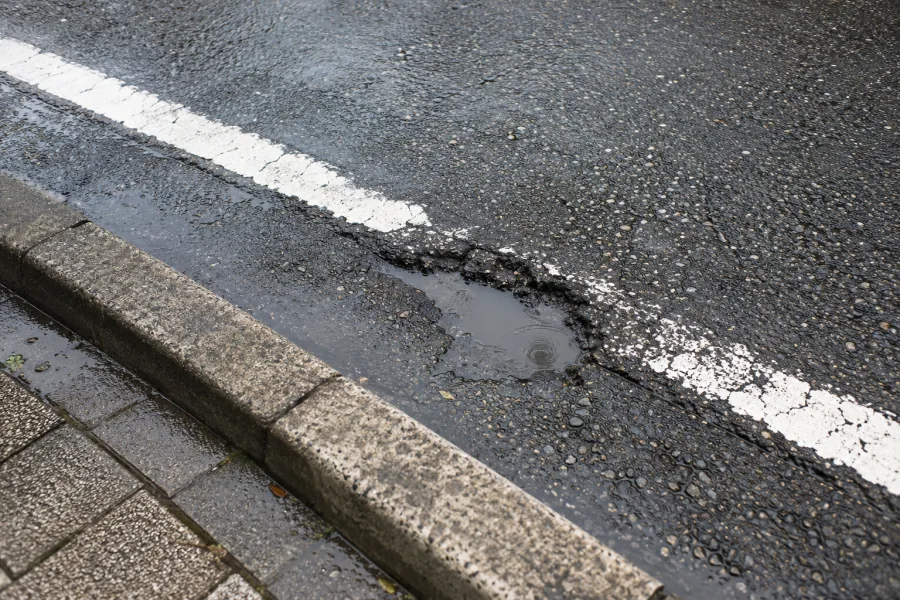
Report a hole in the road to whoever manages that road: the roads section of the city (or ward) office for a municipal road, and the national road office or the prefecture's public works office for a national road. If you don't know whose road it is, you can tell the Road Emergency Dial (#9910) by phone or LINE. If there has been an accident, call 110.
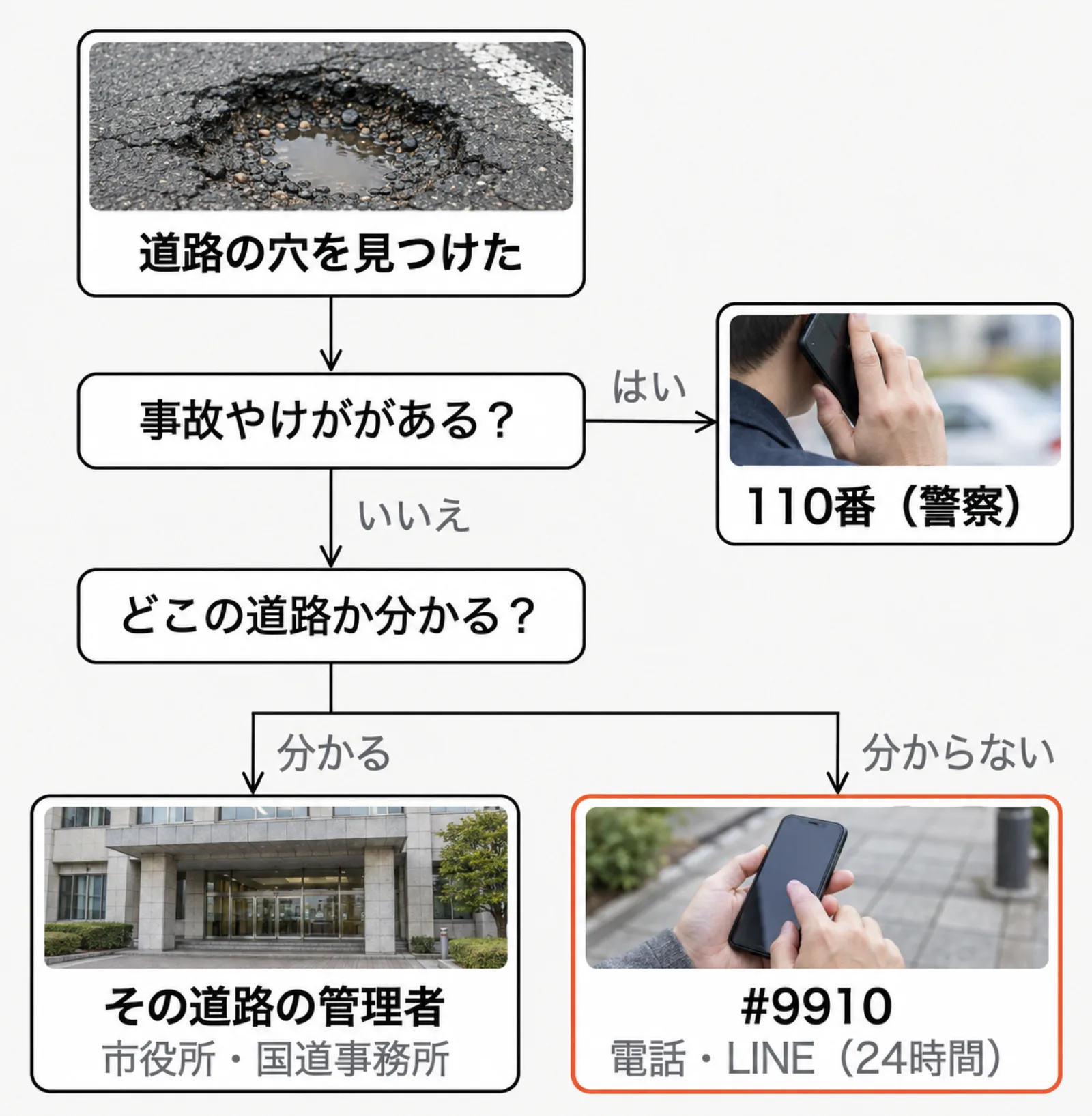
Which road, which contact?
| Road type | Contact |
|---|---|
| Municipal road | Roads section of the city or ward office (phone, the city's LINE reporting, etc.) |
| Prefectural road | The prefecture's public works office, etc. |
| National road | The national road office, or the prefecture's public works office, etc. |
| Don't know whose road | Road Emergency Dial (#9910) |
Even on national roads, the state directly manages only the sections designated by cabinet order; the rest are managed by the prefecture (or, inside designated cities, the city) (Road Act Arts. 13 and 17). So on the same national road, the contact can switch between the national road office and the prefecture's public works office depending on the section. You can roughly tell which road it is from the shape of its route number sign, as explained in National, prefectural or municipal road: how do you tell?
If a hole damages your tyres or wheels, report it to the police separately. What happens next is covered in What if a pothole gives you a flat tyre?
How to use #9910
#9910 is MLIT's nationwide number, free and open 24 hours a day. It takes reports of road problems such as potholes, crumbling shoulders and fallen objects (Source: MLIT). Besides expressways and national roads, it takes reports about prefectural and municipal roads too.
Since March 29, 2024, you can also report through LINE. Add MLIT's official account as a friend and send a photo of the hole and your location (Source: MLIT). If you find it hard to describe the location by phone, LINE may get it across better.
Reports about prefectural and municipal roads may be handled more slowly at night and on weekends and holidays, though. LINE reports for anything other than state-managed national roads and expressways are, in principle, only checked during office hours.
Can you report through your city's LINE or app?
Yes. Many municipalities accept reports of damage to the roads they manage by LINE or app as well as by phone. Hiroshima City lists each ward office's maintenance section as the contact for potholes and also accepts reports through the city's LINE (Source: Hiroshima City).
Fukuoka City also accepts LINE reports where you choose the type of damage and send a photo and location. Chiba City's Chiba Repo puts reported damage on a map where you can also check how the city is dealing with it (Source: Chiba City).
Searching for your city's name with "road report" (道路 通報) will usually turn up the contact. For complaints or questions that aren't urgent, MLIT's road consultation office also helps.
What to say when you report
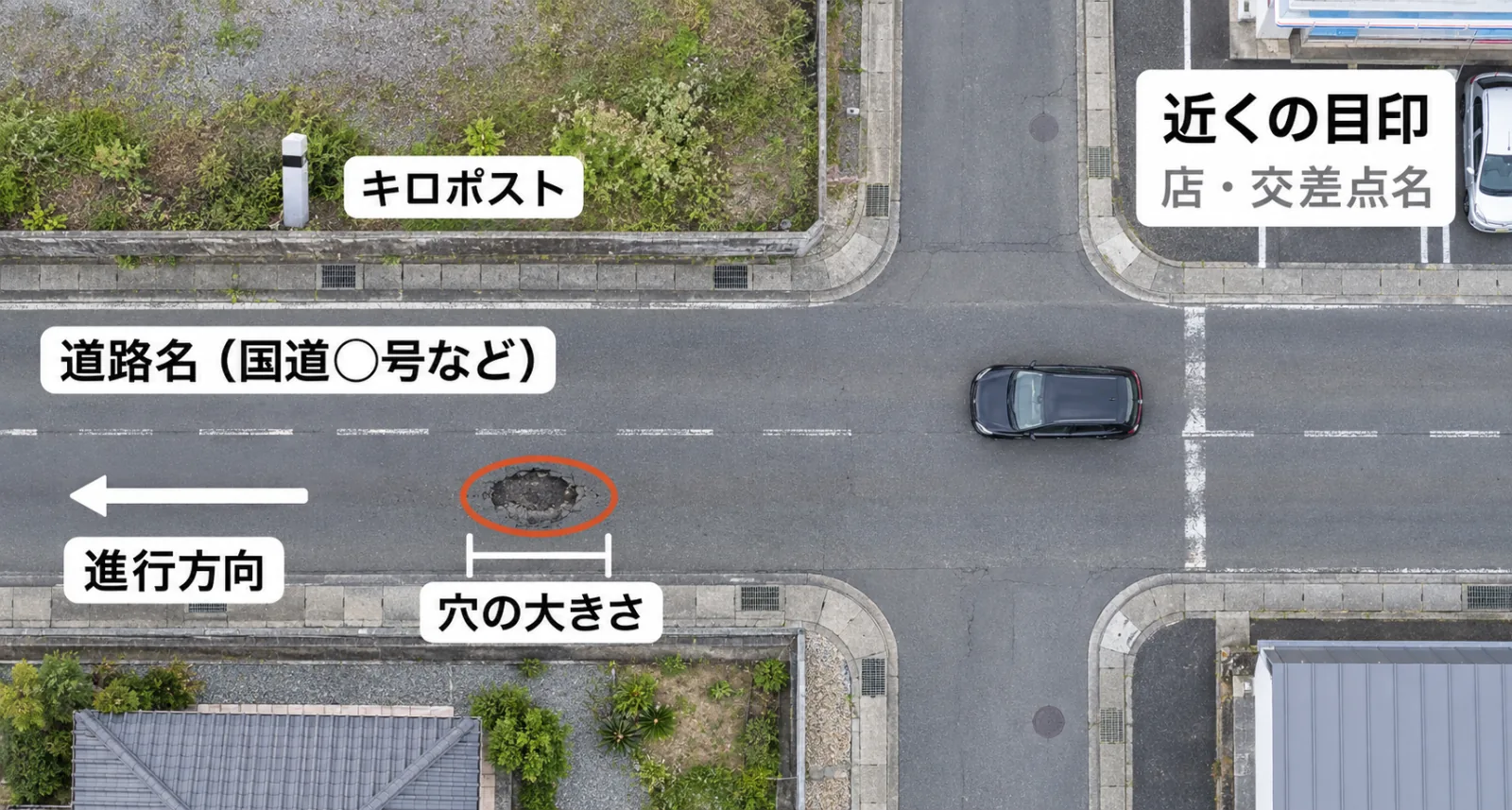
Managers can't find the hole if they don't know where it is. Giving these three things makes it easier for staff to find on site (Sources: MLIT, Tokorozawa City).
- Location: road name, direction of travel, nearby landmarks (an intersection name or a shop). If there is a kilometer post (a small roadside sign showing distance), its number too
- Size: rough width and depth of the hole
- Photo: showing the hole and what's around it
If there are no landmarks nearby, you can open your current location in your phone's map app and give the address it shows. If you report by LINE, you can send your location directly.
Only phone after stopping your car somewhere safe. Never call or use your phone while driving. Take photos from the pavement or shoulder without stepping into the road.
What happens after you report?
The report goes to the section in charge, and staff check the site and decide whether to repair it or keep an eye on it. In Fukuoka City, the ward office's section receives the report and checks the site as needed (Source: Fukuoka City). Reports clearly about national or prefectural roads are passed to those managers.
A report is information for the manager, not a promise of repair. Which holes get fixed when is decided by the manager after looking at the site. Managers patrol regularly, but they can't see every road every day. Reports are an important way to fill those gaps.
FAQ
Q. What if I find one in the middle of the night or on a holiday? #9910 takes reports 24 hours a day, so you can report at any time. City LINE reports can also be sent around the clock, but some cities only check them during weekday office hours (Fukuoka City, for example).
Q. Can I find out whether the hole I reported was fixed? #9910's LINE only sends automatic replies, not individual ones, so the outcome doesn't reach the person who reported. Some systems, like Chiba Repo, show progress on a map, and some cities, like Fukuoka, publish monthly figures on how LINE reports were handled.
Q. Who do I contact about a hole in a private road? Tell the owner of the land. A private road is not managed by the state or a local government, so in principle the owner repairs it. #9910's LINE reports don't cover private land such as private roads either.
For road users: read next Can you fill a hole in the road yourself?
For road managers Infra Intelligence is developing MICHIKARTE, a service that lets people record damage they find on the roads they use every day with a smartphone and passes it on to the local governments and others who manage those roads. See the MICHIKARTE page.
Last checked: September 27, 2026
References (in Japanese)
- MLIT: Road Emergency Dial (#9910)
- MLIT: Road problems anywhere in Japan can now be reported via the LINE app (March 22, 2024)
- e-Gov Law Search: Road Act
- Fukuoka City: Report problems with roads, parks, rivers and more via LINE
- Chiba City: Chiba Repo (My City Report)
- Hiroshima City: If you find a pothole or other problem in the road
- Tokorozawa City: Please help by reporting potholes and other road problems
- MLIT: Road consultation office