Can you fill a hole in the road yourself? Why public roads need approval even at your own cost
In Japan you generally cannot fill a hole in a public road without the road manager's approval, so report it to the local office or #9910. Private roads are repaired by their owners, and some municipalities help with the cost. The difference explained with a flowchart.
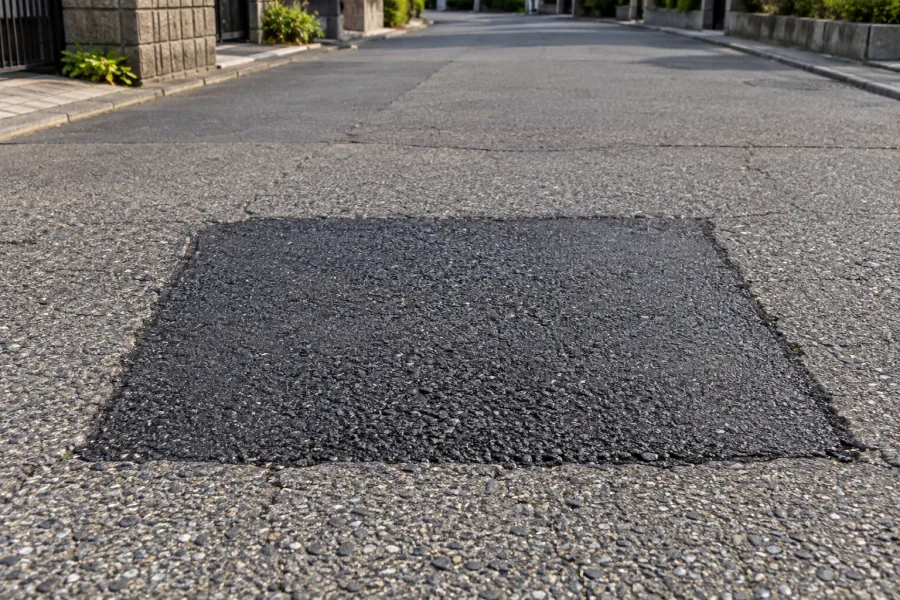
In Japan, holes in public roads, whether national, prefectural or municipal, generally cannot be filled without the road manager's approval (Road Act Art. 24). Instead of filling them yourself, report them to the manager, such as the city office, or to the Road Emergency Dial (#9910). Private roads are repaired by their owners. Some municipalities help with the cost, so check with yours first.
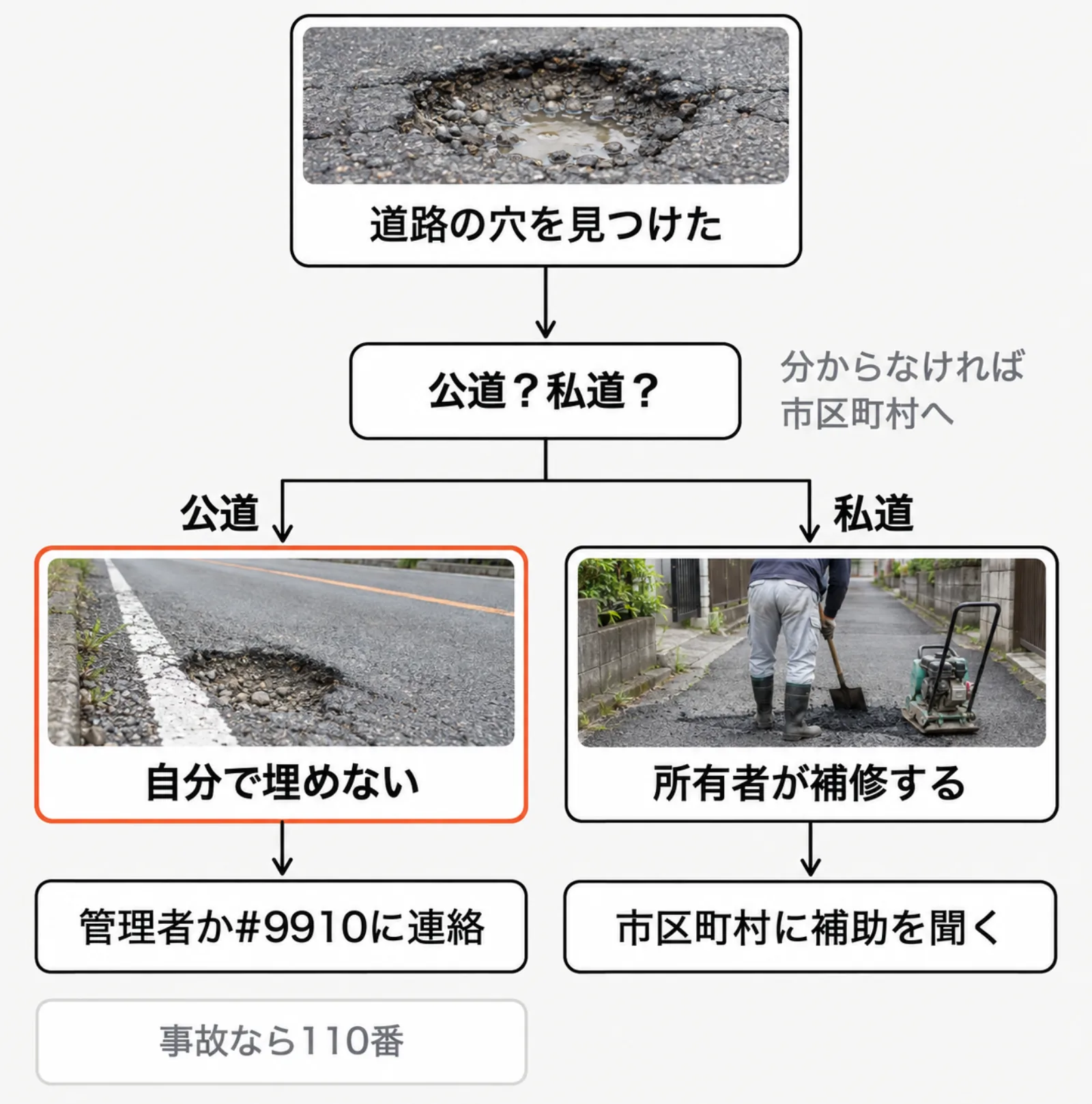
Why not fill a hole in a public road yourself?
Keeping public roads in good condition is the duty of the road manager (national government, prefecture or municipality) (Road Act Art. 42). Anyone else who wants to do work on or maintain a road needs the manager's approval (Road Act Art. 24).
Only "minor maintenance" defined by cabinet order needs no approval. It covers the following (Road Act Enforcement Order Art. 3):
Local topping-up of gravel or soil needed to prevent damage to the road, and other road maintenance that does not affect the road's structure
Whether filling a hole in the pavement counts cannot be settled from the text alone. Check with that road's manager before doing anything. Some local governments explain how to apply for "self-funded works", where you repair the road at your own cost after approval (Source: Yokohama City).
Why it's better not to, even with good intentions
Even if you mean well, there are three reasons to report it rather than fill it yourself.
- Working in the road is dangerous: Holes are where cars and bicycles go. You could be caught up in an accident while working.
- You may hide signs of a collapse: When underground pipes break, the surrounding soil can wash away and leave a void (Source: Bunkyo City). Filling only the surface hides the warning signs. How to tell the difference is explained in Potholes vs road collapses: what's the difference?
- The manager has no record: Potholes are damage that managers fix as soon as they find them on patrols (Source: MLIT). If you fill one quietly, the manager never knows, and if the same spot breaks again it will be noticed later.
Who to contact when you find a hole
| Situation | Contact |
|---|---|
| You found a hole in a public road | That road's manager, or the Road Emergency Dial (#9910) |
| The hole caused an accident | The police (110) |
| You want to repair it yourself or learn the procedure | That road's manager |
#9910 takes reports 24 hours a day by phone and LINE (Source: MLIT). If you don't know where to ask, MLIT's road consultation office can also help (Source: MLIT). Choosing the right contact is explained in detail in Who do you contact when you find a hole in the road?
Who repairs holes in private roads?
Private roads (roads on land owned by individuals and others) are repaired by their owners. A private road is the owner's property, so its upkeep is the owner's responsibility. If a collapse or broken pavement causes an accident, the owner may be liable for damages (Source: Kodaira City, Tokyo). Reports to #9910 via LINE do not cover private roads either (Source: MLIT).
On a private road shared by several owners, whose consent is needed for repairs can become an issue. A Ministry of Justice guideline sets out how to think about it, with examples such as repairing sunken pavement (Source: Ministry of Justice).
Is there help with repairing private roads?
Some municipalities subsidise repair costs. Kodaira City, for example, pays 90% of the cost of paving or drainage work on private roads and carries out the work itself. The main conditions are:
- In principle, roads at least 4 m wide that anyone can use
- Consent from every owner of land facing the road and every resident along it
- Work is done within each year's budget, generally in order of application
Okayama City also has a scheme that subsidises improving private roads that meet its conditions (Source: Okayama City). Before repairing it yourselves, ask your municipality whether it has a subsidy.
FAQ
Q. How do I find out whether the road in front of my house is public or private?
The surest way is to ask the municipality's roads department. Road managers keep a road register and cannot refuse requests to see it (Road Act Art. 28). How to tell them apart is explained in National, prefectural or municipal road: how do you tell?
Q. What if I find it at night or on a holiday?
#9910 takes reports 24 hours a day. However, on roads managed by prefectures and others, an immediate response may not be possible at night or on weekends and holidays. If a hole is dangerous, stay away from it and report it.
This article summarises legal provisions and public documents from national and local governments. It is not a legal judgement on any individual case.
For road users: read next Who do you contact when you find a hole in the road? / National, prefectural or municipal road: how do you tell?
For road managers Infra Intelligence is developing MICHIKARTE, a service that lets people record damage they find on the roads they use every day with a smartphone and passes it on to the local governments and others who manage those roads. See the MICHIKARTE page.
Last checked: September 27, 2026
References (in Japanese)
- e-Gov Law Search: Road Act
- e-Gov Law Search: Road Act Enforcement Order
- Yokohama City: Self-funded road works (Article 24 applications)
- Bunkyo City: Surveys for voids under the road surface
- MLIT Road Bureau: Pavement Inspection Guidelines, October 2016
- MLIT: Road Emergency Dial (#9910)
- MLIT: Road consultation office
- MLIT: Road problems anywhere in Japan can now be reported via the LINE app, March 22, 2024
- Ministry of Justice: Research report on owner consent needed for works on private roads owned by several people, guideline for private roads with unknown owners (2nd ed.), June 2022
- Kodaira City: The city pays 90% of private road repair costs and does the work
- Okayama City: How can I get a private road improved?