A pothole gave me a flat tyre. Will I be compensated? Why the share of fault matters
If a hole in the road gives you a flat tyre, reporting it to the police and then the road manager can lead to compensation under the State Redress Act. But in some cases the city paid only 20% or 40%. What to do on the spot, which photos to take, real examples of fault shares, and the deadline for claims.

If a hole in the road damages your tyres or wheels, the road manager may pay compensation under Japan's State Redress Act. It isn't always the full amount; in one case the city paid 20%. Stop somewhere safe, report it to 110, photograph the hole and your car, and then contact that road's manager.
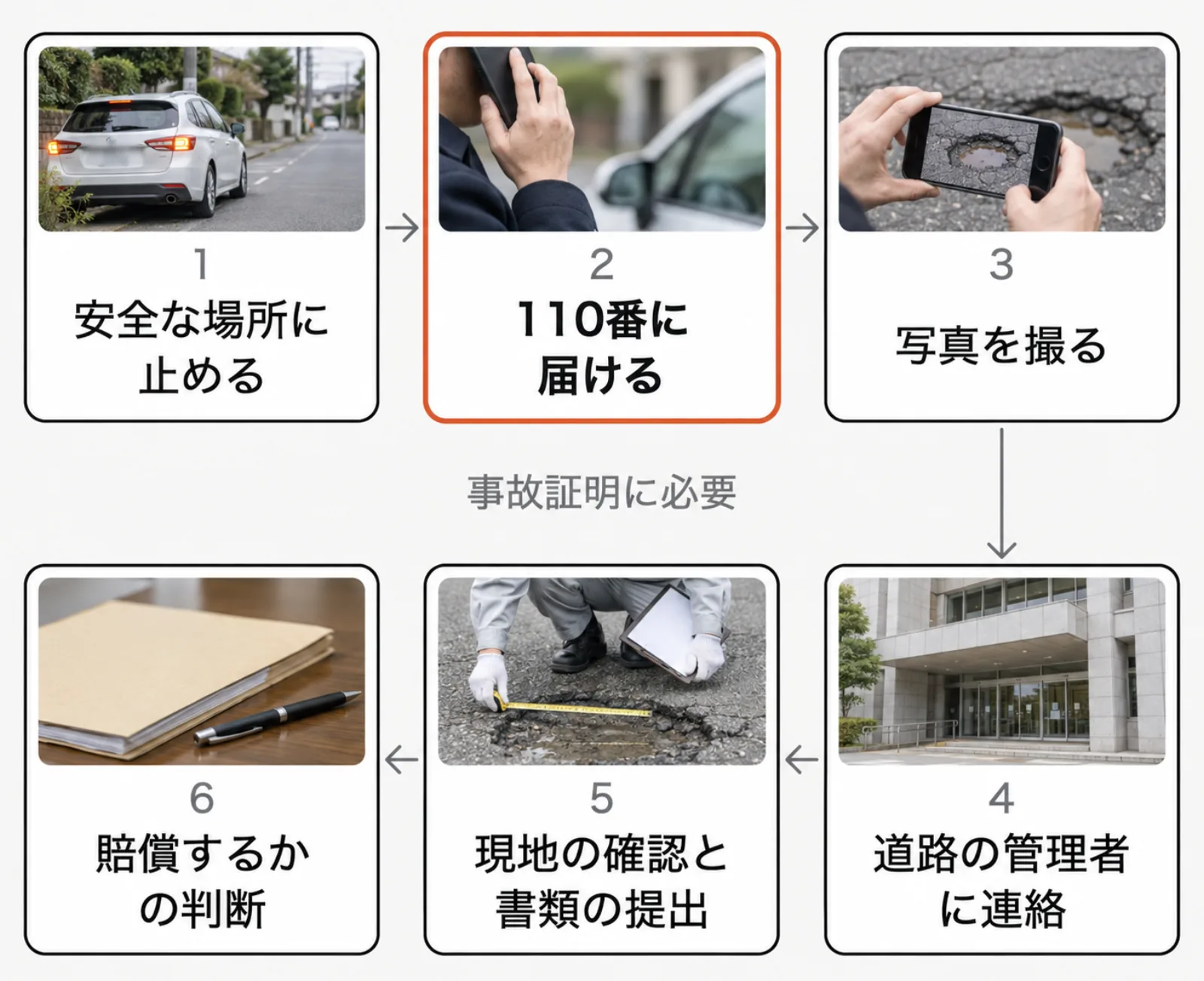
What to do first
There are three things to do on the spot.
- Watch out for traffic behind you, stop somewhere safe, and call 119 if anyone is hurt
- Call 110 and report it as an accident
- From somewhere safe, photograph the hole and your car
Driving on with a flat can break the wheel as well as the tyre and make the damage worse. Rather than forcing the car on, consider calling roadside assistance.
Calling 110 is essential if you later want to discuss compensation, because a traffic accident certificate isn't issued for accidents not reported to the police. Applications can in principle be made within five years for accidents with injuries and three years for property-only accidents (Source: Japan Safe Driving Center).
Drivers involved in a traffic accident are required to report it to the police (Road Traffic Act Art. 72(1)). Report it even if no one else was involved, and note the police station and the officer's name.
Which photos to take
Holes get repaired over time, so their shape at the time of the accident won't last. To explain the situation to the manager, take these four photos on the spot. The time they were taken also becomes part of the record.
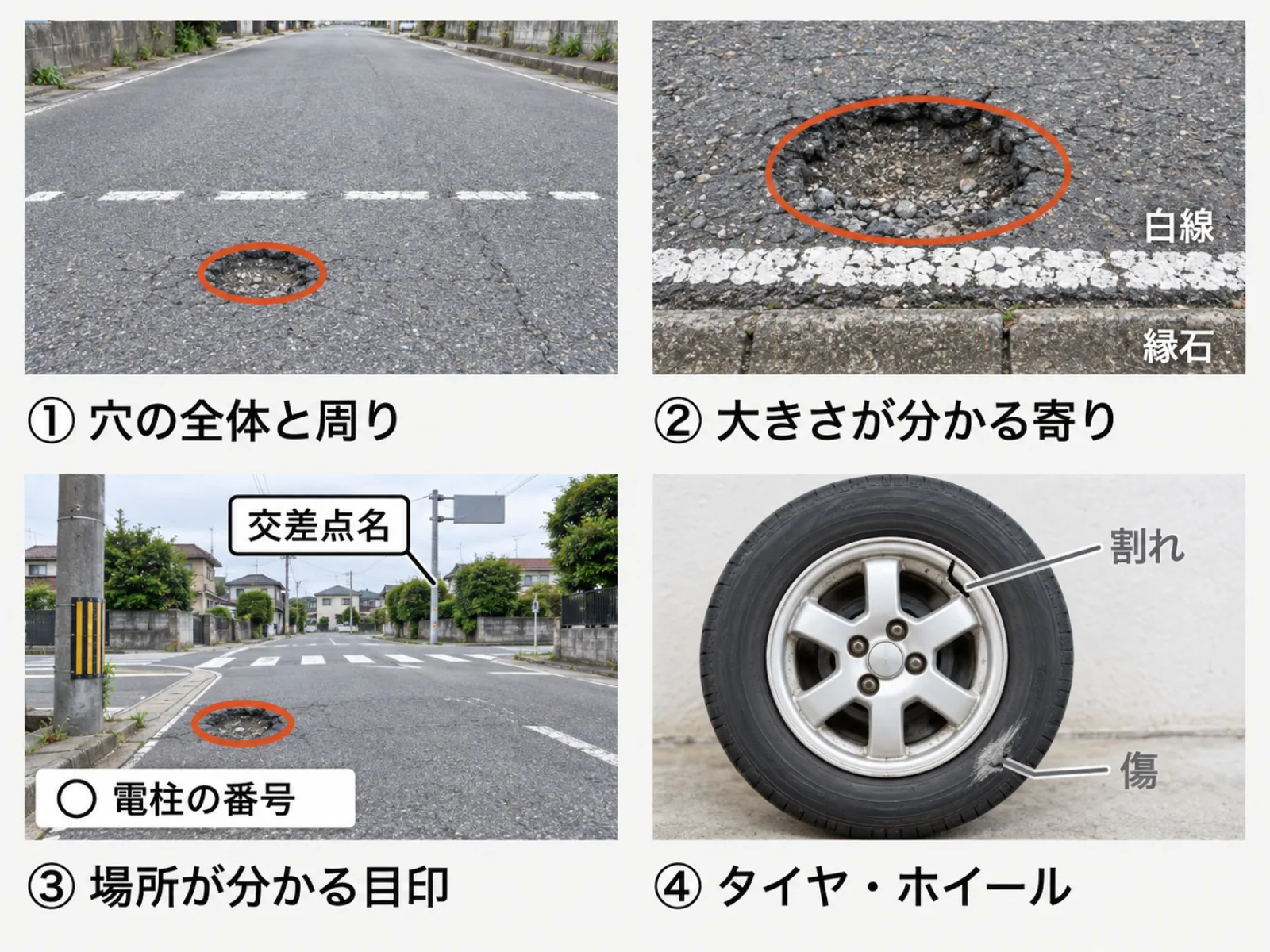
The hole's size comes across when photographed next to something of known size, such as a white line, kerb or manhole cover. At night, also take a wide shot showing where the streetlights are and how far you could see. Don't step into a busy carriageway or onto a blind bend to take photos.
Keep the damaged tyre or wheel rather than throwing it away until the manager has checked. Ask the repair shop to photograph the damage before replacing anything.
Who to contact
Compensation is discussed with the manager of the road where the accident happened. The manager depends on the type of road (Road Act Arts. 13 and 15 to 17).
| Road | Contact |
|---|---|
| Municipal road | Roads section of the city, ward, town or village office |
| Prefectural road | The prefecture's public works office, etc. (the city, inside designated cities) |
| National road | The national road office (state-managed sections), or the prefecture or designated city |
| Expressway | That expressway company's contact point |
Even on the same national road, the contact differs by section. In Takayama, Gifu Prefecture, for example, city roads go to the city's maintenance section, National Route 41 to the state's Takayama National Road Office, and other national and prefectural roads to Gifu Prefecture's public works office (Source: Takayama City).
If you don't know which road it is, see National, prefectural or municipal road: how do you tell?
When is compensation paid?
Article 2(1) of the State Redress Act says the state or local government pays compensation when damage results from a defect in the construction or management of a road. A defect means the road lacks the safety it should normally have, and the Supreme Court has held that the manager is liable even without negligence (Supreme Court judgment of August 20, 1970).
That doesn't mean every dangerous condition is a defect, though. In a case on a road under construction where a sign had been knocked over by another vehicle just before the accident, with no time to put it back, the manager was not held liable (Supreme Court judgment of June 26, 1975). The questions are whether the manager could have known about the condition and had time to fix it (Source: MLIT).
How you were driving also matters. In a case where a driver going about 80 km/h on a prefectural road with a 50 km/h limit crashed on a dip in the road, the manager was not held liable (Osaka District Court judgment of February 22, 1979). Kanazawa City says damage caused by natural disasters such as heavy snow is not covered (Source: Kanazawa City).
Will you get the full amount? Why the share of fault matters
Even when the manager is held liable, if the driver was also at fault, compensation is reduced by that share. When a municipality settles an amount, it may be reported to the council as a mayor's discretionary decision (decided by the mayor in place of the council), and the shares may be made public.
| City | Accident | City's share |
|---|---|---|
| Shiroi, Chiba | August 2021, front left wheel dropped into a hole in a city road, causing a flat | 40% (paid ¥6,924) |
| Takayama, Gifu | February 2015, front left wheels and more of three cars damaged by a sunken hole in a city road | 20% (all three cars) |
In the Takayama case, three cars were damaged by the same hole within about half a day. The damage was ¥12,310 to ¥79,272 per car, and the city paid 20%, ¥2,462 to ¥15,854 (Source: Takayama City). Shiroi City put its own fault at 40% and the driver's at 60% (Source: Shiroi City).
Both shares were reached through talks between the city and the driver (settlement). Photos taken on the spot and the accident certificate are among the few records that can later show how big the hole was and how visible it was at the time.
Steps and deadlines for a claim
When you contact the manager, you'll be asked the date, time and place of the accident, your contact details and the damage. Some managers, like Takayama, check the site. You then submit the documents requested, and the manager decides whether to pay and how much.
Have these ready:
- Traffic accident certificate (¥1,000 per copy; post office application forms are also available at police stations and police boxes)
- Photos of the hole and car, and a map showing where the accident happened
- Repair estimates and receipts
- If you were injured, a medical certificate and records of treatment
Kanazawa City's accident report form also lists a location map of the site, photos, the accident certificate and medical certificate as attachments (Source: Kanazawa City form). Also note when you made contact, which office, the person you spoke to and what you were told.
Claims have a deadline. Under Article 4 of the State Redress Act the Civil Code applies, and the right to claim expires three years (five years for harm to life or body) after you learned of the damage and who was responsible (Civil Code Arts. 724 and 724-2). Even if you had the repairs done quickly, keep the photos and receipts and get in touch early.
FAQ
Q. Can I use my own car insurance? It depends on your policy. Alongside claiming from the manager, check with your insurer or agent.
Q. What if I only notice a cracked wheel after getting home? Report it to the police and contact the road manager as soon as you notice. The longer you wait, the more likely the hole is repaired and the harder it is to show the link to the accident.
Q. What if I was hurt on a bicycle or on foot? The contact is the same: the road manager. Okayama City's guidance also uses the same contact for damaged vehicles and injuries (Source: Okayama City). Get treatment first, and ask for a medical certificate.
Q. What if I just want to report where the hole is? So the next person isn't hurt the same way, tell the manager or the Road Emergency Dial (#9910). #9910 is free, open 24 hours, and also takes reports via LINE (Source: MLIT).
This article is general information. It does not judge whether any individual accident will be compensated or what the share of fault is.
For road users: read next National, prefectural or municipal road: how do you tell? / Who do you contact when you find a hole in the road?
For road managers Infra Intelligence is developing MICHIKARTE, a service that lets people record damage they find on the roads they use every day with a smartphone and passes it on to the local governments and others who manage those roads. See the MICHIKARTE page.
Last checked: October 22, 2026
References (in Japanese)
- e-Gov Law Search: State Redress Act
- e-Gov Law Search: Civil Code
- e-Gov Law Search: Road Act
- e-Gov Law Search: Road Traffic Act
- Japan Safe Driving Center: How to apply (certificates for traffic accidents)
- MLIT: Case law on Article 2 of the State Redress Act
- Takayama City: Report on discretionary decisions (2015)
- Shiroi City: Report on discretionary decisions (November 24, 2021)
- Takayama City: If your car was damaged (or you were hurt) by a pothole or step in the road
- Kanazawa City: Injuries (vehicle damage) caused by road damage
- Kanazawa City: Items to confirm for accidents caused by defects in road construction or management
- Okayama City: Does the city compensate if my car was damaged (or I was hurt) by a pothole or step in a city road?
- MLIT: Road Emergency Dial (#9910)