What are Japan's Pavement Inspection Guidelines? And why pothole response is left out
MLIT's Pavement Inspection Guidelines sort roads into classes A to D, set inspections for A and B at roughly once every five years or more, and diagnose pavement in three levels, I to III. The key points in tables, why pothole response is excluded, and how resident reports fit in.

Japan's Pavement Inspection Guidelines (MLIT, October 2016) sort roads into classes A to D. Classes A and B are inspected at roughly once every five years or more; classes C and D follow an inspection plan the manager sets (Source: MLIT). Diagnosis has three levels: I Sound, II Surface function maintenance stage, and III Repair stage. Emergency response to sudden damage such as potholes is outside the guidelines and is handled as soon as it is found on patrols and the like.
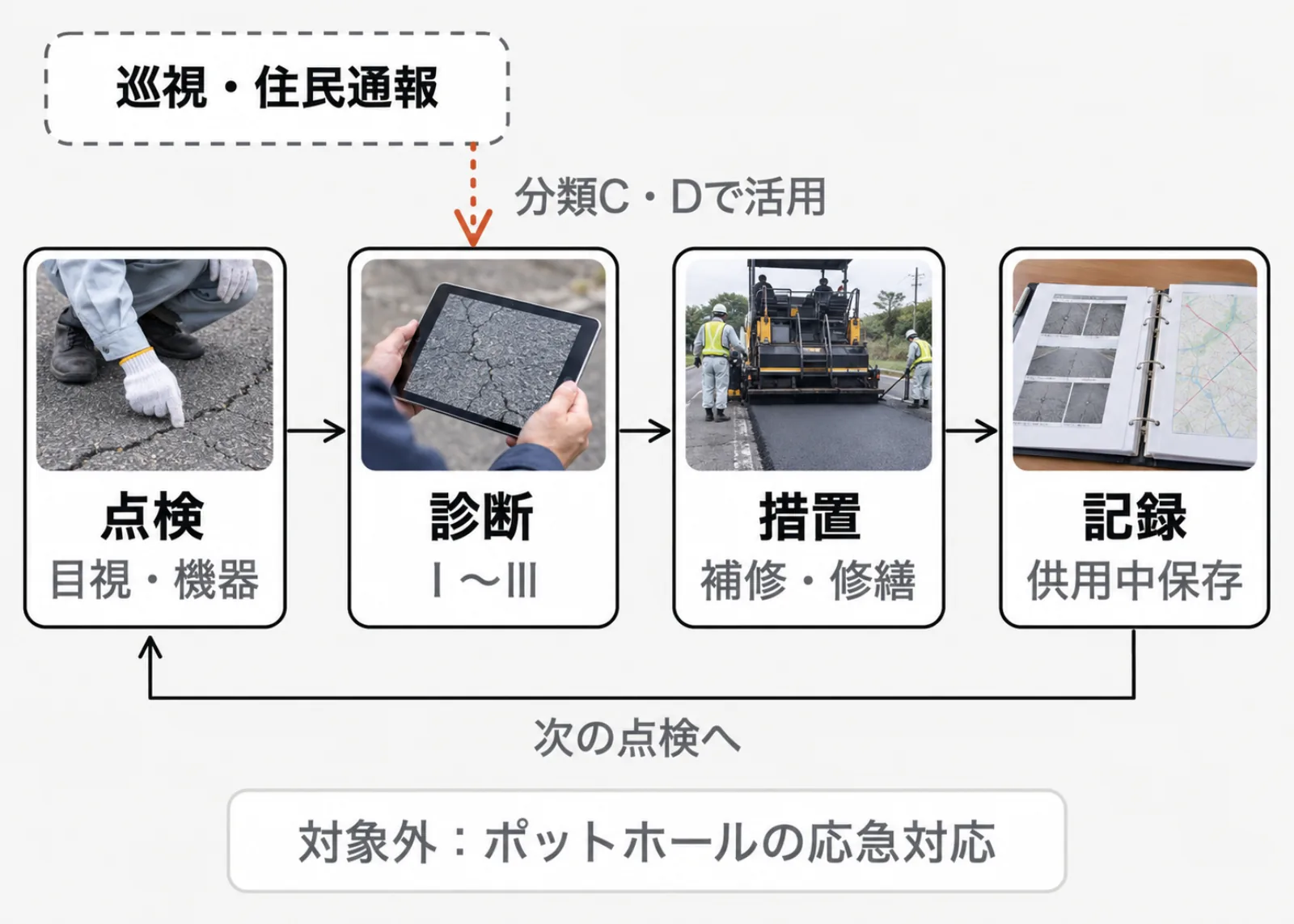
Key points of the guidelines
The guidelines set out the basics of pavement inspection under Article 35-2 of the Road Act Enforcement Order. Bridges and tunnels are covered by separate rules, based on close visual inspection every five years with four diagnosis levels, I to IV, so don't confuse them with pavement's three levels (Sources: Road Act Enforcement Regulations Art. 4-5-6, MLIT notice).
| Item | What the guidelines say |
|---|---|
| Covers | Carriageway pavement (including on bridges and in tunnels) |
| Excludes | Emergency response to sudden damage such as potholes |
| Road classes | Four, A to D. The road manager decides which applies |
| Inspection frequency (A, B) | Set by the manager, roughly once every five years or more |
| How inspection proceeds (C, D) | The inspection plan sets how many years one full round takes |
| Management indicators | For A and B, basically crack ratio, rut depth and IRI (roughness). For C and D, set by the manager |
| Diagnosis | I Sound / II Surface function maintenance stage / III Repair stage |
| Records | Results of inspection, diagnosis and action are kept for as long as the pavement is in service |
The table describes asphalt pavement. Concrete pavement has separate rules in Chapter 7, where level II is called the "minor repair stage".
How are classes A to D decided?
| Class | Typical roads | How fast damage progresses |
|---|---|---|
| A | High-standard arterial highways and other roads with high service levels such as high-speed travel | Fast |
| B | Roads with heavy truck traffic, roads where pavement deteriorates quickly, etc. | Fast |
| C | Roads with light truck traffic, etc. | Gradual |
| D | Residential streets, etc. | Very slow |
Each road manager decides the class. The guidelines note that a municipal road may be put in class B at the manager's discretion, and ask for reviews as traffic changes.
How often are inspections?
For classes A and B, the manager sets the frequency at roughly once every five years or more. A target service life, the period the surface is meant to stay in use without rehabilitation, is also set, and inspections are judged against it. The manager chooses the method, such as visual inspection or equipment.
Classes C and D have no fixed number of years; the inspection plan sets how many years one round takes. Where intervals are long, the guidelines say it is desirable to fill in with information from patrols. For class D, managing by finding damage during patrols, then acting on and recording it, is acceptable.
Roads managed by the state have their own version of the guidelines (March 2017). All state-managed national roads are class B, and the basic rule is to inspect every lane of every route once every five years (Source: MLIT).
Rough thresholds for levels I to III
Diagnosis is made against the management standard the manager has set. The guidelines' appendix gives example judgements for a standard of 40% crack ratio and 40 mm rut depth, stressing that these are only examples. For classes C and D, examples include crack ratios of 20 to 40% and rut depths of 20 to 40 mm.
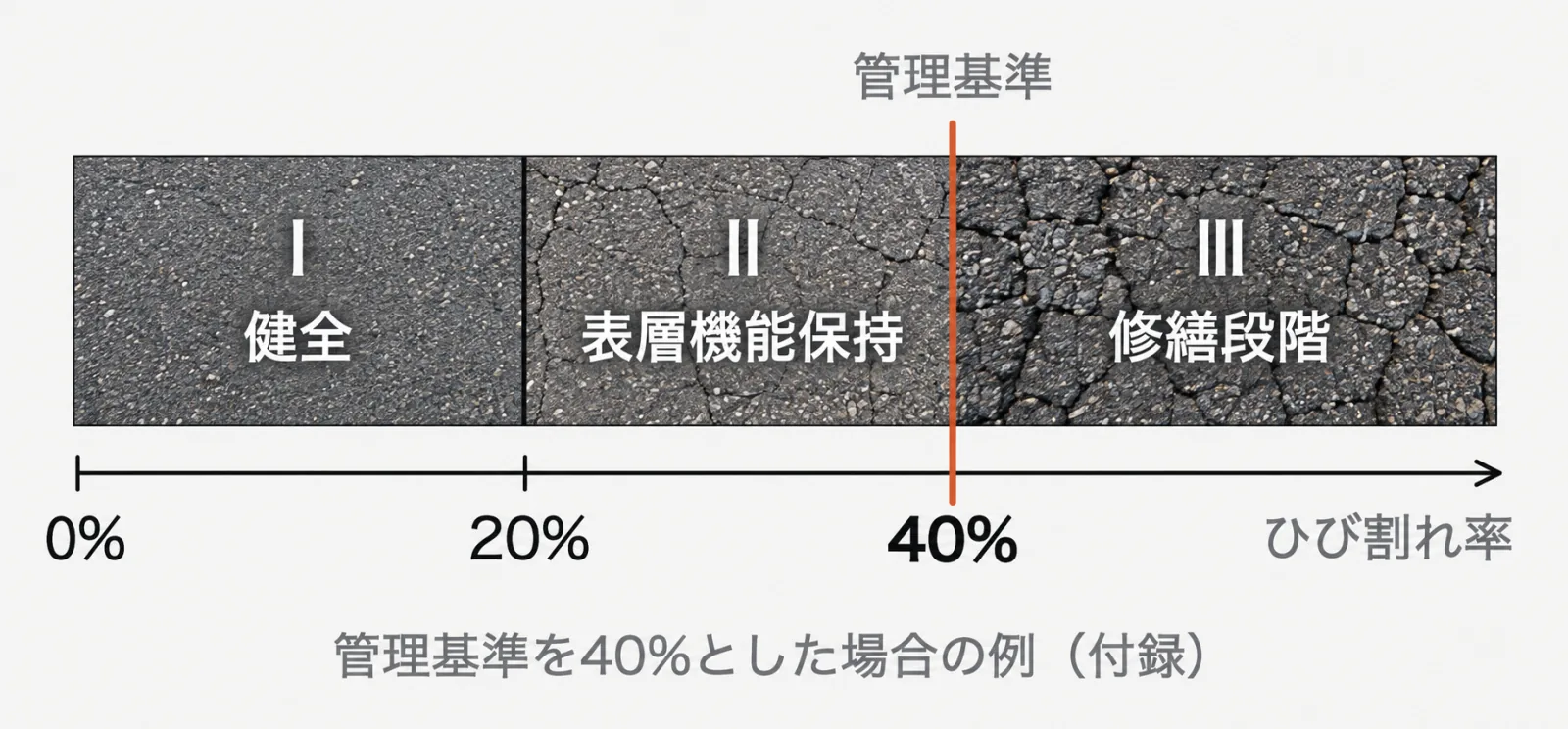
| Level | Crack ratio | Rut depth |
|---|---|---|
| I Sound | About 0 to 20% | About 0 to 20 mm |
| II Surface function maintenance stage | About 20 to 40% | About 20 to 40 mm |
| III Repair stage | About 40% or more | About 40 mm or more |
For IRI (International Roughness Index, the longitudinal unevenness of the surface), the appendix gives class A and B examples of up to about 3 mm/m for I, about 3 to 8 mm/m for II, and about 8 mm/m or more for III. In the guidelines, rehabilitation restores the original function, while minor repair keeps the current function while still below the management standard.
At level II, if the pavement looks likely to reach III before its target service life, minor repairs such as sealing cracks are carried out. For classes A and B, level III splits into III-1 (surface rehabilitation) if the surface has been in service longer than its target life, and III-2 (base course replacement, etc.) if not, since damage below the base course is suspected. III-1 is mainly milling and overlay; III-2 involves a detailed survey followed by base course replacement or similar.
Why is pothole response excluded?
The guidelines aim to make pavement last longer by rehabilitating the surface and binder courses early and protecting the layers below the base course. Dealing with sudden, safety-related damage such as potholes is a different kind of task, so the guidelines exclude it as "something to be dealt with as soon as it is found on patrols and the like".
Deciding from patrol information that cracks need sealing, and doing it, is within the guidelines, though. How holes form is explained in Why do potholes form?
How do the guidelines treat resident reports?
I am developing a service that passes residents' reports on to road managers, so I'll also be clear about the limits of reports. The guidelines mention resident reports in two places, and not in the section on asphalt pavement for classes A and B.
- In the notes on diagnosis and action for classes C and D: information from patrols and from handling resident reports is also used. On roads where a full inspection round has not yet been completed, damage equivalent to level II or III may be identified from reports and acted on
- In the notes on concrete pavement: if there is a report of problems at joints, it is good to check the condition visually case by case
| Information the manager needs | Can reports provide it? |
|---|---|
| Location, date and appearance of damage | Yes. A lead until the inspection round comes around |
| Crack ratio, rut depth and IRI values | No. They are section-level indicators that one photo can't determine |
| Surface service years and condition below the base course | No. Registers and detailed surveys are needed |
Reports skew towards busy streets, the same damage gets reported several times, and people judge severity differently. Reports are no substitute for periodic inspection; treating them as information that fills the gaps between inspections on roads with long intervals, like classes C and D, matches how the guidelines are written.
How do you check which version is current?
Check the list of inspection guidelines on MLIT's road deterioration countermeasures page (Source: MLIT). As of September 27, 2026 it lists the October 2016 version; the "March 2017" guidelines that come up in searches are the version for state-managed roads.
Read next Who do you contact when you find a hole in the road? / What to decide before ordering image detection AI
For road managers I am developing MICHIKARTE, a service that lets road users record damage they find with a smartphone and passes it on to road managers.
Last checked: September 27, 2026
References (in Japanese)
- MLIT Road Bureau: Pavement Inspection Guidelines, October 2016
- MLIT Road Bureau, National Roads and Disaster Management Division: Pavement Inspection Guidelines, March 2017
- MLIT: Countermeasures for aging roads
- MLIT: Notice on classification of diagnosis results for tunnels and other structures
- e-Gov Law Search: Road Act Enforcement Order
- e-Gov Law Search: Road Act Enforcement Regulations