Why do potholes form? And why there are more in early spring than in the coldest month
A pothole is a hole where pavement breaks up because rainwater gets in through cracks and the weight of passing vehicles keeps pressing on it. The four stages from crack to hole, shown in diagrams, and who to contact when you find one.
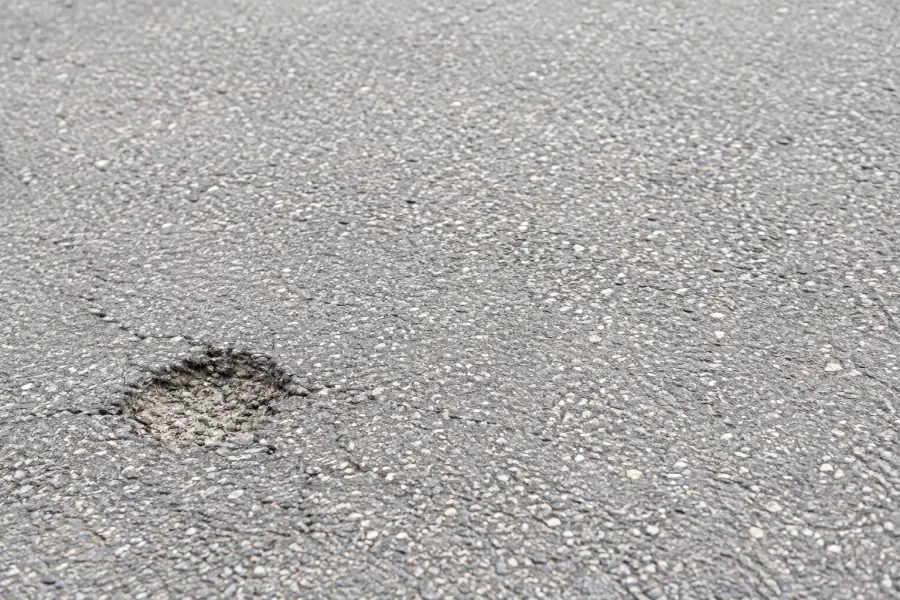
A pothole forms when rainwater soaks in through cracks in the pavement and the repeated weight of vehicles breaks the pavement up from below. In cold regions, the water that soaks in freezes and thaws again and again, so potholes multiply when the snow melts. If you find one, contact that road's manager or the Road Emergency Dial (#9910).
What is a pothole?
A pothole is a hole where the surface of asphalt pavement has broken away. Most are a few tens of centimetres across and a few centimetres deep (Source: Civil Engineering Research Institute for Cold Region). The round holes worn into riverbed rock share the name, but this article is about holes in roads.
How does a crack become a hole?
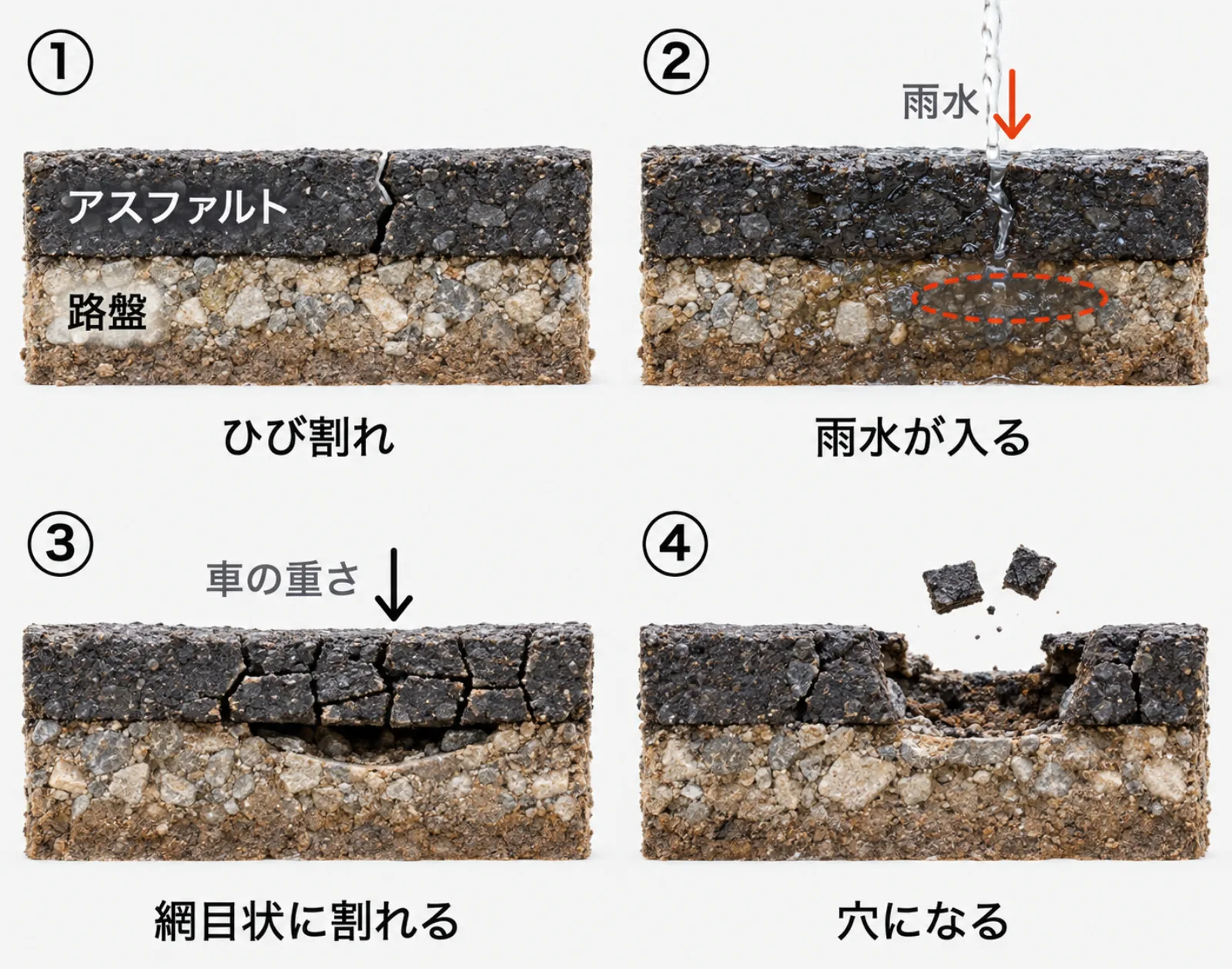
The Civil Engineering Research Institute for Cold Region sums up the main causes of pavement damage in the snowmelt season as water, temperature changes and vehicle loads. Typically a hole forms through the four stages in Fig. 1.
- Vehicle loads and temperature changes crack old pavement
- Rainwater gets in through the cracks and soaks into the base course (a layer of crushed stone and similar) below
- The wet base course turns muddy and loses its strength, a gap opens under the pavement, and the cracks spread into a mesh
- Pieces of pavement with nothing left to hold them up are knocked out by tyres, leaving a hole
Mesh-like cracking is the step just before a hole. Most holes form where there is mesh cracking (the shares are given in a later section).
Why are there more after rain and in the snowmelt season?
Where there are cracks, rainwater goes almost straight through to the layers below. In the institute's tests, even a crack 0.5 to 1 mm wide let about 600 mL of water through in 15 seconds, and cracks 3 mm or wider hit the measurable maximum of 1,400 mL per 15 seconds. In milder parts of Japan such as Honshu, potholes are said to be most common in the rainy season and during typhoons and autumn rains.
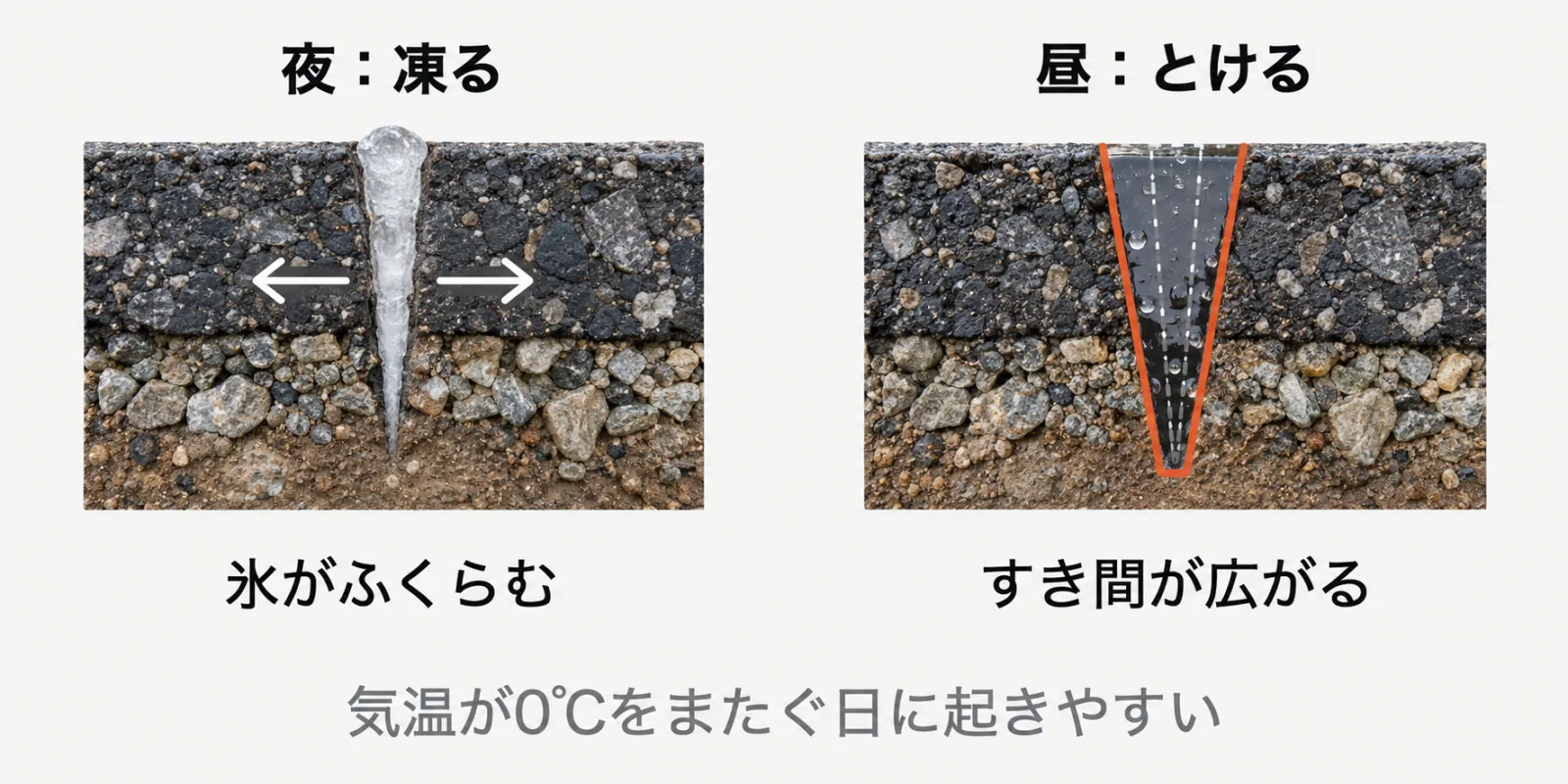
Cold regions add freezing and thawing. Water in a crack expands when it freezes, opening gaps inside the pavement and between layers. Wet base course material also loses strength once it freezes and thaws.
In the institute's year-long survey of three national roads (about 160 km in all) in the Engaru area of Hokkaido, holes started to increase gradually from February and were found most in March and April, as the snow melted. None were found in January, the coldest month. Most were found on days when the temperature crossed 0°C, freezing and thawing. Across the 78 days with patrol records, holes were found on 24 of the 40 days when the temperature crossed 0°C within the day (zero crossings), or 60%. On the 38 days without a crossing, it was 6 days, about 16%.
Where do they tend to form?
Where water can get in and where water collects. In the institute's surveys, holes were most common:
- Around cracks (on National Route 337 near Sapporo, mesh cracks alone accounted for about 90%; in Engaru, mesh and transverse cracks together accounted for about 80%)
- Around pavement joints (where pavement laid in separate works meets)
- Where meltwater flows in or pools
- On sections with a lot of surface cracking
Roads with many heavy vehicles also deteriorate faster. Japan's national pavement inspection guidelines suggest inspecting the surface of such roads at least about once every five years (Source: MLIT, Pavement Inspection Guidelines).
Can it be stopped before it becomes a hole?
At the crack stage, injecting sealant (a material that fills gaps) closes the way in for rainwater. The national guidelines list sealing cracks as a repair that protects the layers below the base course. The institute also names crack injection, filling cracks and joints with filler, as an effective way to prevent potholes.
Once there is a hole, it is filled with repair material (patching). In cold regions during the snowmelt season, asphalt plants are often shut, so holes are filled with material that can be used at normal temperatures (cold mix). The institute lists removing water and crumbling material before filling as an effective step.
Who to contact when you find one
Contact that road's manager: the city office for a municipal road, the prefecture's public works office for a prefectural road, or the national road office for a national road managed by the state. If you don't know who manages it, you can report to the Road Emergency Dial (#9910) (Source: MLIT). If there has been an accident, call 110.
The national guidelines treat potholes separately from periodic inspection, to be dealt with as soon as they are found on patrols and the like. But patrols alone can't find them all. MLIT's Hachinohe national road maintenance office notes that some problems are missed depending on when the patrol car passes, and asks people to call #9910 (Source: MLIT Hachinohe).
If you see a hole while driving, slow down to pass it. Don't fill it yourself; leave it to the manager. If a hole damages your car, see What to do when a pothole gives you a flat tyre
If a wide area of the road has sunk, it may be a road collapse rather than a pothole. A collapse is a different kind of failure, where the road surface drops into a void underground.
For road users: read next Who to contact when you find a hole in the road / Potholes vs road collapses
For road managers Infra Intelligence is developing MICHIKARTE, a service that lets people record damage they find on the roads they use every day with a smartphone and passes it on to the local governments and others who manage those roads.
Last checked: September 28, 2026
References (in Japanese)
- MLIT: Road Emergency Dial (#9910)
- MLIT Road Bureau: Pavement Inspection Guidelines, October 2016
- Kimio Maruyama, Ryuji Abe, Takashi Kimura (Civil Engineering Research Institute for Cold Region, PWRI): Pavement damage in the snowmelt season and how it happens
- MLIT Tohoku Regional Bureau, Hachinohe National Road Maintenance Office: Newsletter Vol. 117