Potholes vs road collapses: why voids turn up under roads rated "sound"
A pothole is a hole where the pavement itself has broken up; a road collapse is where the surface drops into a void underground. You don't need to tell them apart: report either to the road manager. The difference explained with cross-sections.

A pothole is a hole where the pavement itself has broken up from water getting in through cracks and the weight of vehicles. A road collapse happens when soil washes away underground, for example through gaps in buried pipes, leaving a void, and the road surface above loses its support and drops. You don't need to tell them apart by eye: report either to that road's manager (or #9910 if you don't know who it is), and call 110 if there has been an accident.
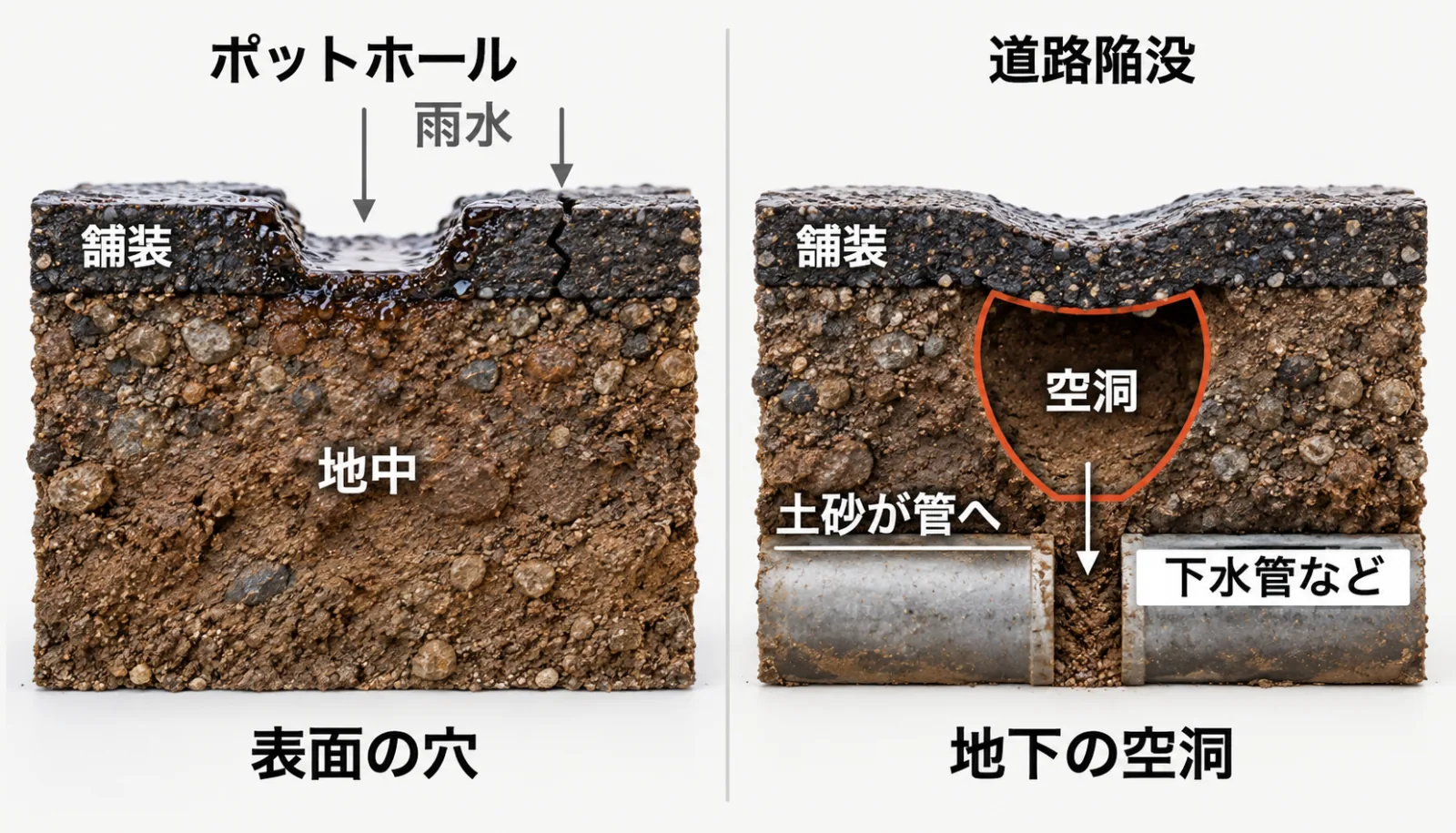
The difference at a glance
| Pothole | Road collapse | |
|---|---|---|
| Where it fails | The surface pavement | The ground beneath the pavement |
| Main cause | Rainwater through cracks plus vehicle loads | Soil washing away through gaps in pipes, etc. |
| Warning signs | Often visible as cracking | Hard to see from the surface |
| Contact | Road manager or #9910 (110 for accidents) | Same as for potholes |
Why do potholes form?
As asphalt pavement ages, cracks appear on its surface. When rainwater soaks in, every passing vehicle squeezes fine material from under the pavement out with the water, and the cracks spread into a mesh. Eventually the finely broken pavement comes away and leaves a hole (Source: Ibaraki Prefecture). In cold regions, water in the gaps also freezes and expands overnight, prising them wider (Source: MLIT Hachinohe National Road Maintenance Office).
Only the surface pavement fails; there is no large void underground. Even so, a shallow hole can damage tyres and wheels or bring down a bicycle or motorcycle. Why they multiply after rain and in winter is explained with diagrams in Why do potholes form?
Why do roads collapse?
A road collapse starts underground. Beneath the road run sewer pipes, road drainage pipes and more. When soil flows into an old pipe through its joints or cracks, an equal volume of void forms in the ground. As the void grows, the road surface above loses its support and drops.
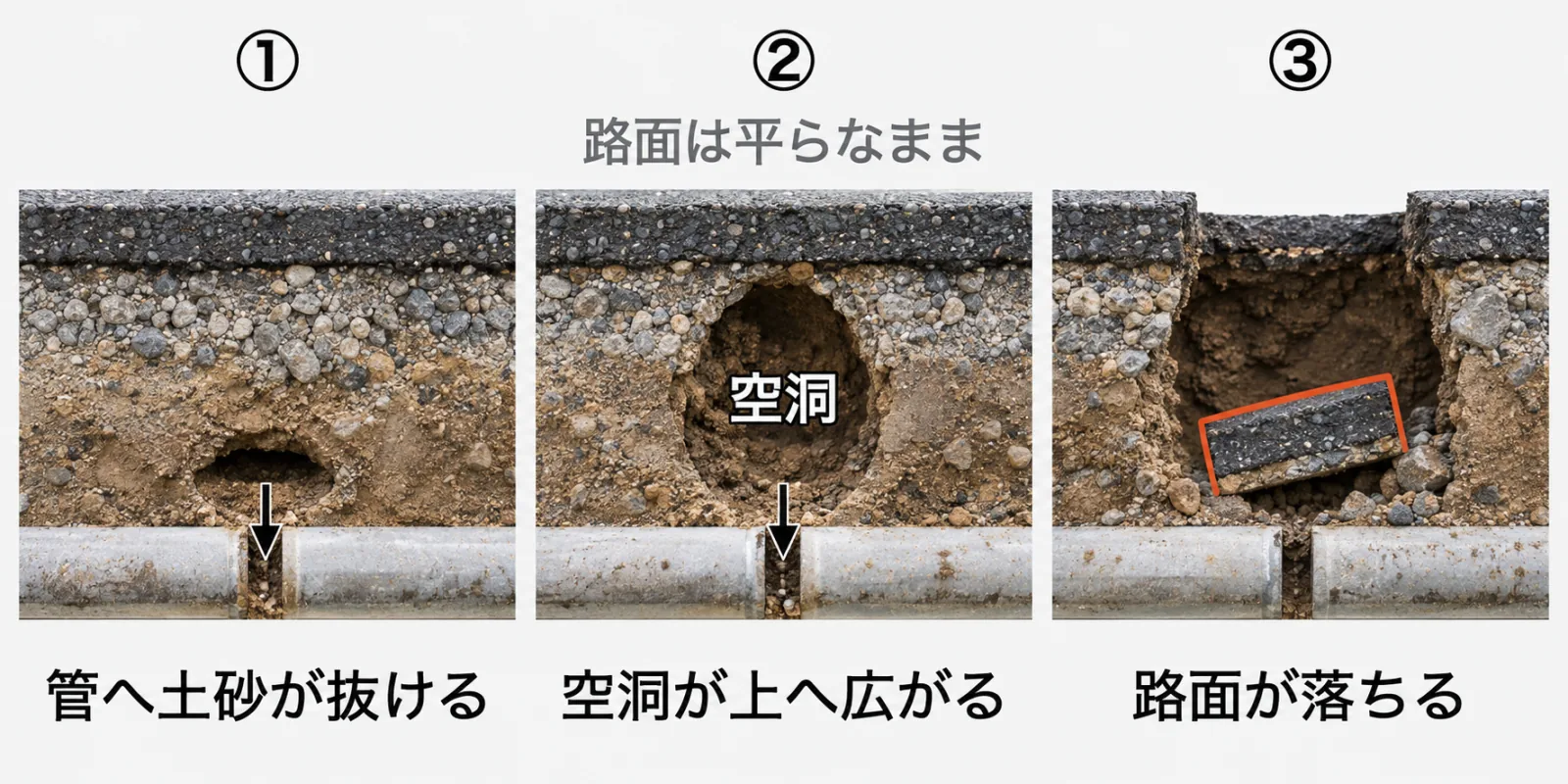
In fiscal 2025 there were 101 road collapses on state-managed national roads, 1,282 on prefectural roads and 9,844 on municipal roads. These figures do not include potholes. Many were caused by facilities that carry water, such as sewers and road drainage (Source: MLIT). In cities, the share caused by sewer pipes and other pipes buried under roads is higher.
In January 2025, a road collapse thought to have been caused by a broken sewer pipe occurred in Yashio, Saitama Prefecture (Source: MLIT).
Can you spot a collapse coming?
Voids underground can't be seen from the surface. About 80% of the places on state-managed national roads where collapses or voids were found had been rated "sound" in surveys of surface cracking and the like (Source: Kanto Regional Development Bureau). Those surveys measure the condition of the surface, so the same document says their results could not be linked to where voids or collapses occurred. A road that looks fine can still have a void beneath it.
So road managers carry out subsurface void surveys, which examine what's under the road without digging. A survey vehicle with ground-penetrating radar picks up unusual readings as it drives, then a small hole is drilled at each spot and a camera checks inside (Source: Tokyo Metropolitan Government). On state-managed national roads, the fiscal 2025 surveys found 194 voids with a high chance of collapse, and repairs have begun on all of them.
What to do if you find one
- Stay away from the edges of the hole or dip (you can't tell from outside what's underneath)
- If there has been an accident, call 110
- Tell the road manager or #9910 its rough size, whether it is spreading and when you noticed it
Besides the address, landmarks such as a nearby intersection or shop name, or the number on a utility pole, make the location easier to find. If you take photos, do so from somewhere safe like the pavement, and don't step into the road.
The Road Emergency Dial (#9910) takes reports of potholes and other road damage 24 hours a day, free of charge (Source: MLIT). Choosing between city and national contacts is explained in Who to contact when you find a hole in the road
FAQ
Q. Can I report even a small hole or dip? Yes. #9910 lists potholes among the things it takes reports on. Holes spread if left alone, so it's fine to report them while they're small.
Q. Can I report steps or sinking around manholes? Yes. Whether there's a void under a dip can't be told from outside. Don't try to work it out; just report what you noticed and the manager will investigate.
Q. What should I do if a hole or collapse damages my car? Report it to the police on the spot and talk to the road manager about the damage. Whether compensation applies is decided case by case. The steps are explained in Who to talk to when a hole in the road damages your car
For road users: read next Who to contact when you find a hole in the road / Who to talk to when a hole in the road damages your car
For road managers Infra Intelligence is developing MICHIKARTE, a service that lets people record damage they find on the roads they use every day with a smartphone and passes it on to the local governments and others who manage those roads. See the MICHIKARTE page.
Last checked: September 27, 2026
References (in Japanese)
- MLIT Road Bureau: FY2025 inspection results for bridges and other structures, Road Maintenance Annual Report (3rd cycle, year 2), press release
- Ibaraki Prefecture: How asphalt pavement deteriorates
- MLIT Kanto Regional Development Bureau, Hibiki Hatori: On drafting guidelines for preventing road surface collapses
- MLIT Tohoku Regional Bureau, Hachinohe National Road Maintenance Office: Newsletter Vol. 117
- Tokyo Metropolitan Civil Engineering Support and Training Center: Results of excavation surveys of subsurface voids, Annual Report 2012
- MLIT: Request to carry out a nationwide special priority survey of sewer pipes, following the expert committee's recommendations
- MLIT: Road Emergency Dial (#9910)