Yellow lines vs white lines on Japanese roads, and why the same yellow means different things
A solid yellow line bans crossing to overtake, a solid white line is the centre line of a road at least 6 m wide per direction, and a broken white line can be crossed to overtake when the view is clear. Lane lines and edge lines explained with diagrams.
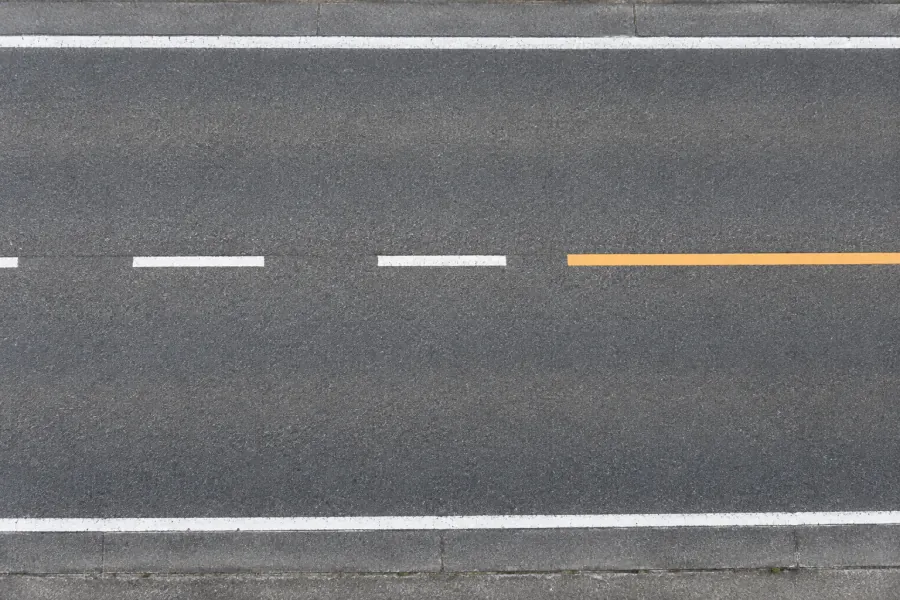
On Japanese roads, the centre line's meaning depends on its colour and on whether it is solid or broken. A solid yellow line bans crossing to the right to overtake. A solid white line is the centre line of a road at least 6 m wide in each direction, and you may not cross it to overtake either. A broken white line is the centre line of a road less than 6 m wide per direction; if the view is clear and you won't obstruct oncoming traffic, you may cross it to overtake.
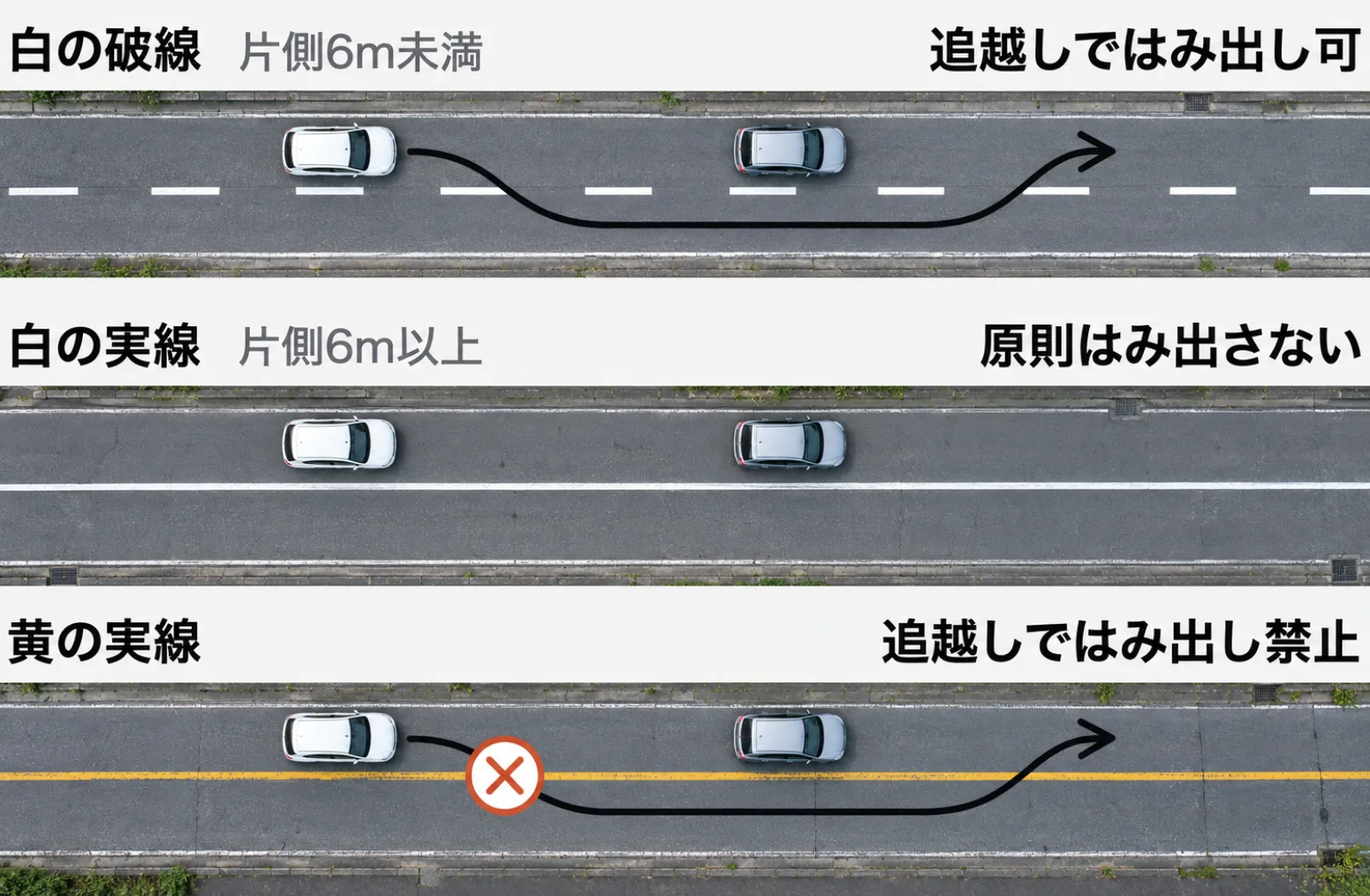
There are three kinds of centre line
In Japan vehicles drive on the left of the road's centre, and where a centre line is painted, that line is the "centre". You may cross to the right to overtake only on roads less than 6 m wide per direction, and only when you can see ahead and won't obstruct oncoming traffic (Source: Road Traffic Act, Art. 17(4) and 17(5)(iv)).
| Line | Meaning | Cross to overtake? |
|---|---|---|
| Broken white | Centre line of a road under 6 m per side | Yes, if the view is clear |
| Solid white | Centre line of a road 6 m or more per side, etc. | No |
| Solid yellow | No crossing to overtake | No |
Even where crossing is allowed, the rules say to cross as little as possible.
On roads with no centre line, you still drive to the left of the centre. Under the National Police Agency's standards, centre lines are in principle painted on roads with at least 6.5 m of pavement, so narrower roads often have none (Source: National Police Agency, Traffic Regulation Standards).
Solid or broken white depends on road width
A white centre line is solid on roads whose paved width is at least 6 m per side, and where the law bans overtaking, such as near bends; it is broken on roads under 6 m. Lines are normally 15 cm wide, and broken lines are 5 m painted and 5 m gap. On multi-lane roads, or near sharp bends with many crossover crashes, the centre line may be two solid white lines (Source: National Police Agency, Traffic Regulation Standards).
A solid white line does not itself mean "no crossing". Crossing to overtake is only allowed on roads under 6 m per side, so on wider roads the basic rule of keeping left simply stays in force. It is easier to think of the solid line as a marker saying "this is a wide road (or a no-overtaking zone)".
Can you cross a yellow line to avoid a hole or roadworks?
What a solid yellow line bans is crossing to overtake. The Road Traffic Act says that when you cannot use the left side because of damage to the road, roadworks or another obstruction, you may cross to the right (Road Traffic Act, Art. 17(5)(iii)). This applies regardless of the line's colour, and includes avoiding a hole or a works zone. Even then, you must cross as little as possible.
The yellow looks almost orange because the National Police Agency standard is based on a yellow-red colour (Munsell 5.5YR 6.5/12) (Traffic Regulation Standards).
Do lines between lanes mean something different?
On roads with two or more lanes in one direction, the line separating lanes going the same way is a lane line, not a centre line. If it is broken white, you may change lanes. If it is yellow, it marks "no lane changes" and you may not cross it to change lanes (Road Traffic Act, Art. 26-2(3)).
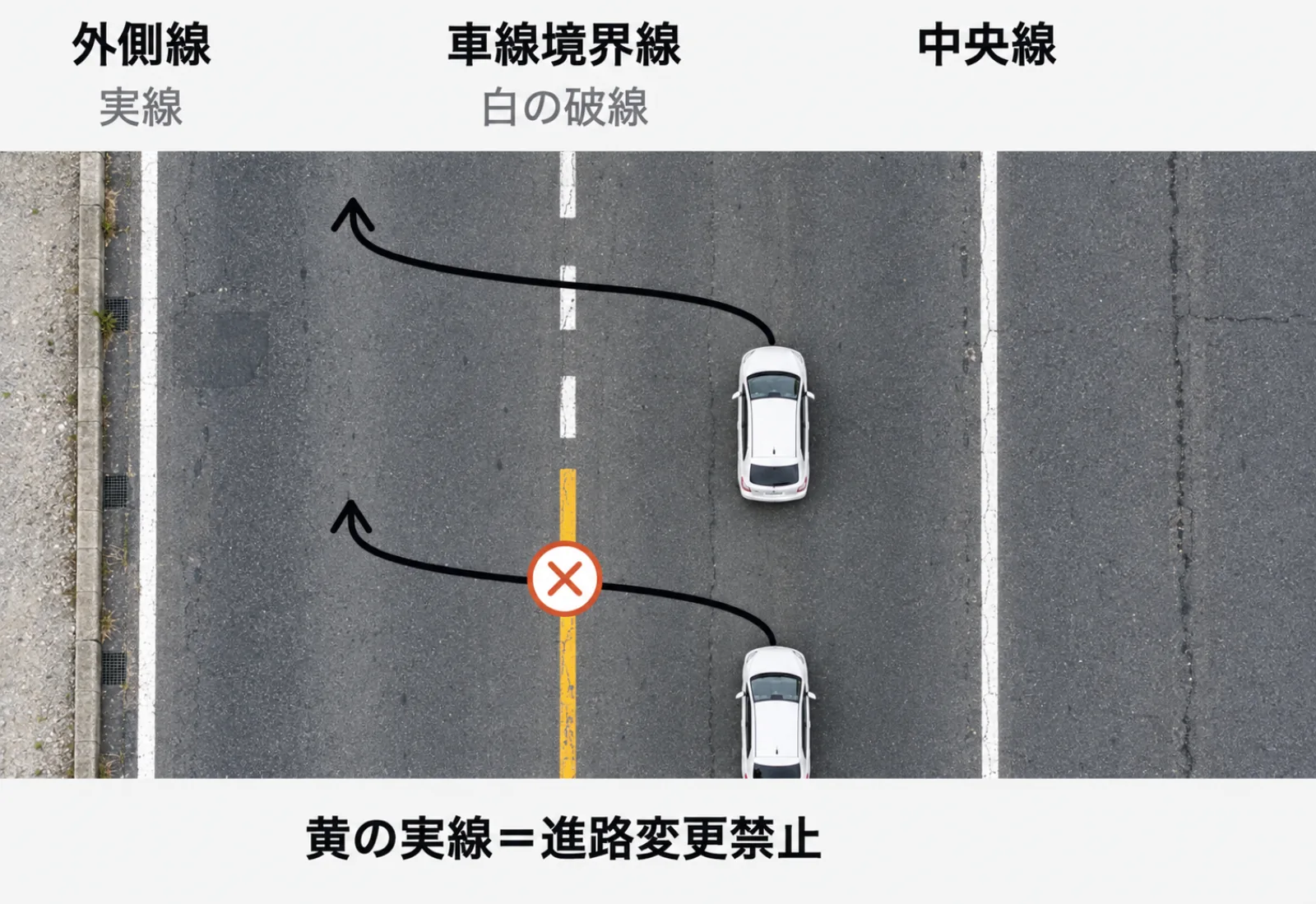
When a white line and a yellow line run side by side, you may not cross if the yellow is on your side. From the other lane, the white line is on your side, so you may change lanes (Source: National Police Agency, Rules of the Road).
What is the white line at the edge of the road?
The white line along the left edge is the roadway edge line, marking the edge of the carriageway. A solid edge line on a side with no pavement is legally treated as a roadside strip, a strip for pedestrians outside the white line (Order on Road Signs, Lane Lines and Road Markings, Art. 7). Whether vehicles may enter and stop in a roadside strip depends on how many lines it has. The three types are shown in What are the gutters and white lines at the edge of the road for?
FAQ
Q. Who repaints faded white lines?
Lane lines such as centre and edge lines are put in by the road manager (national government, prefecture or municipality), while road markings such as yellow no-crossing lines and crosswalks are put in by the prefectural public safety commission (the police) (Road Act Art. 45, Road Traffic Act Art. 4). To find who to contact about faded lines, see Who do you contact when you find a hole in the road?
Q. What do three lines, yellow, white, yellow, mean?
The same as a solid yellow line: no crossing to overtake. It is used where the ban needs extra emphasis (Traffic Regulation Standards). Where a centre line is one yellow line and one white line side by side, only vehicles on the yellow side may not cross to overtake.
Q. Why do white lines seem to glow at night?
Road markings put in by the police are, in principle, made with materials that reflect headlights (Traffic Regulation Standards). Yellow no-crossing lines, crosswalks and the like use brighter reflective materials so they stay visible at night and in rain.
This article does not judge whether any particular situation is a violation.
For road users: read next What are the gutters and white lines at the edge of the road for? / Who do you contact when you find a hole in the road?
For road managers Infra Intelligence is developing MICHIKARTE, a service that lets people record damage they find on the roads they use every day with a smartphone and passes it on to the local governments and others who manage those roads. See the MICHIKARTE page.
Last checked: September 27, 2026