What are the gutters and white lines at the edge of the road for? Why the space outside the same line can be a roadside strip or a shoulder
The channel at the edge of the road is a gutter that collects and carries away rainwater. Roads are slightly higher in the middle, so rain runs to the edges. How to tell whether the space outside the white line is a roadside strip or a shoulder, and what kerbs and reflector posts do.
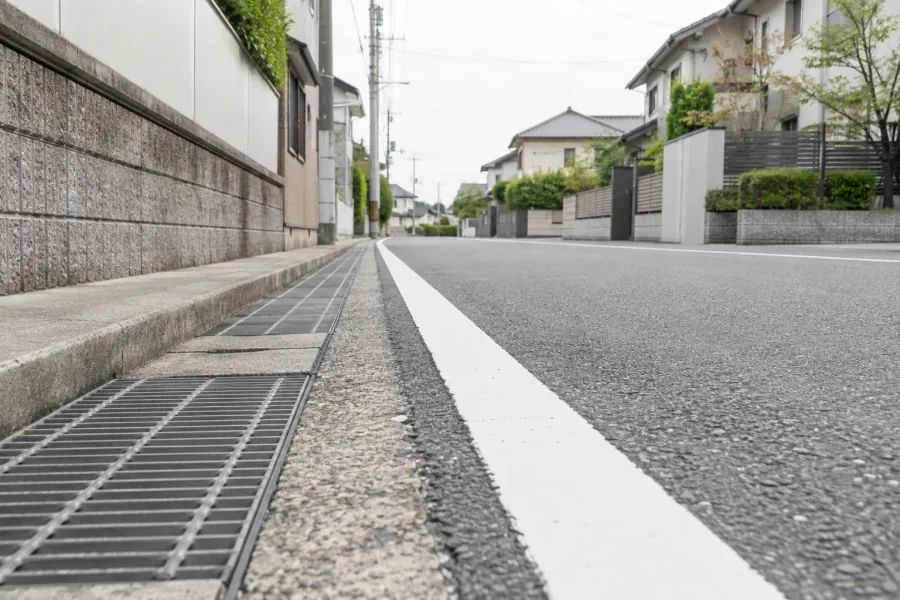
The channel at the edge of the road is a gutter that collects and carries away rainwater. Roads are built slightly higher in the middle, so rain flows to the edges and gathers in gutters and catch basins. The space outside the white edge line is a roadside strip for pedestrians on roads without a pavement, and a shoulder, a margin that protects the road, on roads with one.
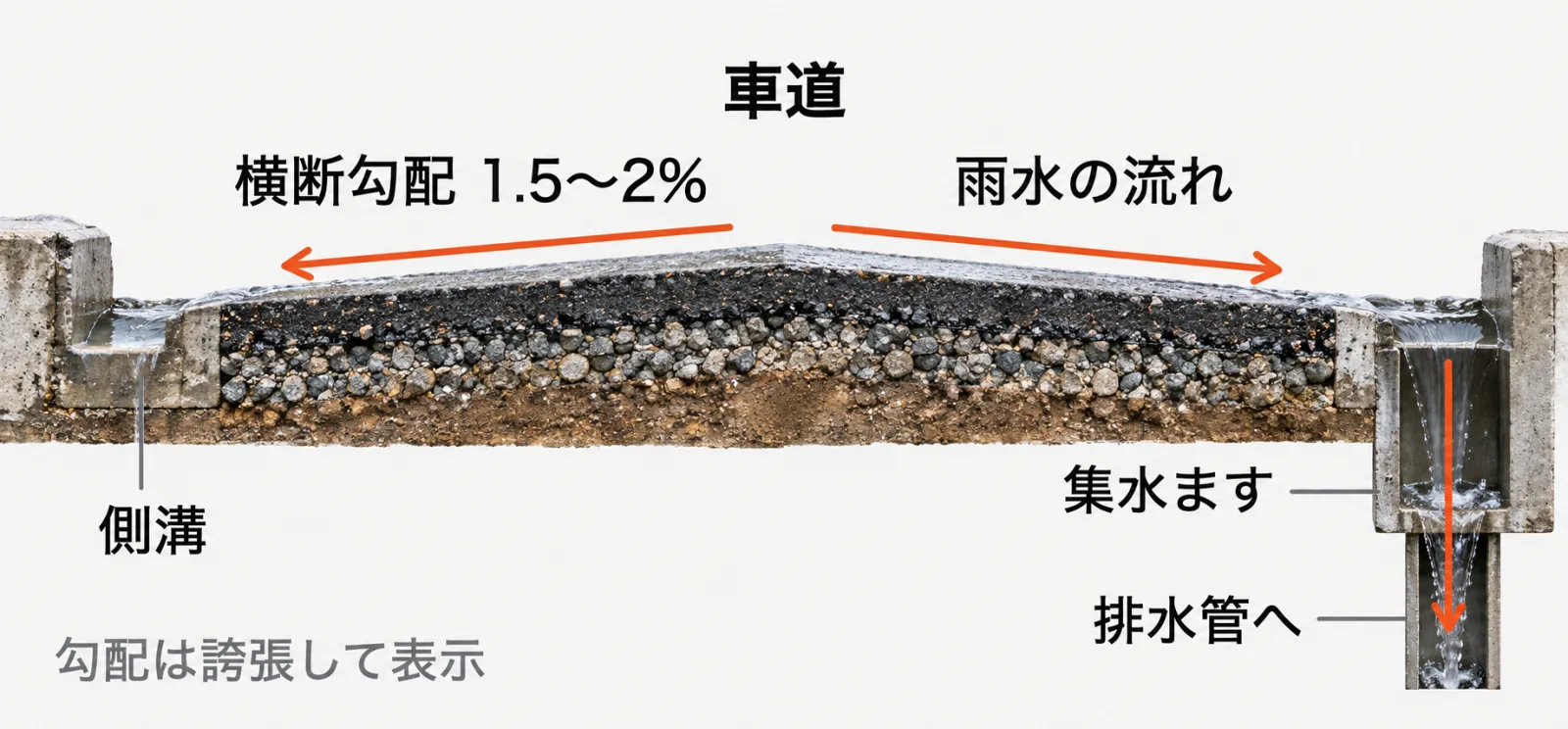
Why is there a channel at the edge of the road?
To get rainwater off the road. Roads are to have drainage facilities such as gutters and catch basins where needed for drainage (Road Structure Ordinance Art. 26). Water standing on the road gets splashed onto people walking by passing cars, and makes skidding more likely. Water soaking into the pavement also makes it deteriorate.
Rain on the road surface runs along the gutter and drops into catch basins (boxes that receive rainwater) placed at intervals. Square grated covers spaced along the edge of the road usually have a catch basin underneath. From there it flows through underground pipes to sewers and rivers. If catch basins are clogged with leaves or rubbish, a short heavy downpour can flood the road (Source: Funabashi City). Some local governments, like Funabashi, ask residents to clear leaves and rubbish off the basins.
Roads are built slightly higher in the middle
Rain runs to the edges because the carriageway has a sideways slope (cross slope). The standard cross slope for a paved carriageway is 1.5 to 2%, a drop of 1.5 to 2 cm for every metre across (Road Structure Ordinance Art. 24). Pavements are sloped too, at a standard 2%. That's why, even though the road looks flat, water drifts to the edges on rainy days.
On pavement designed to let rainwater soak into the ground, the slope can be reduced or left out as long as drainage isn't affected. How water-permeable pavement works is covered in What types of asphalt are used on roads?
What is the grid on the gutter cover?
The grid cover is an iron cover called a grating. It lets only water through while people and vehicles can pass over it. Its advantage is that it closes the channel so people and bicycles don't fall in, while still taking in rainwater. Like catch basins, it stops letting water in once leaves or rubbish pile up on the grid.
In residential areas, the channels themselves mainly come in two shapes.
- U-shaped gutters: Concrete channels with a U-shaped cross-section, often used with a cover on top.
- L-shaped gutters: Shallow channels built into the kerb, laid along the edge of the carriageway to take water from the road surface.
Even on residential streets without a pavement, a continuous concrete strip with a shallow dip along the edge is an L-shaped gutter.
What are kerbs for?
The raised blocks between the pavement and the carriageway are kerbs. MLIT describes three roles for them (Source: MLIT road consultation office).
- Making the boundary between pavement and carriageway clear
- Stopping vehicles from running onto the pavement
- Stopping rainwater from flowing onto the pavement and towards houses
There are standard heights too. Under the road standards based on Japan's Barrier-Free Act, kerbs are at least 15 cm above the carriageway and the pavement surface is a standard 5 cm above it. Only where the pavement meets a crosswalk is the step reduced, to a standard 2 cm (Ministerial Ordinance on Barrier-Free Standards Arts. 7 to 9).
Outside the white line: shoulder or roadside strip?
It depends on whether there is a pavement (Fig. 2).
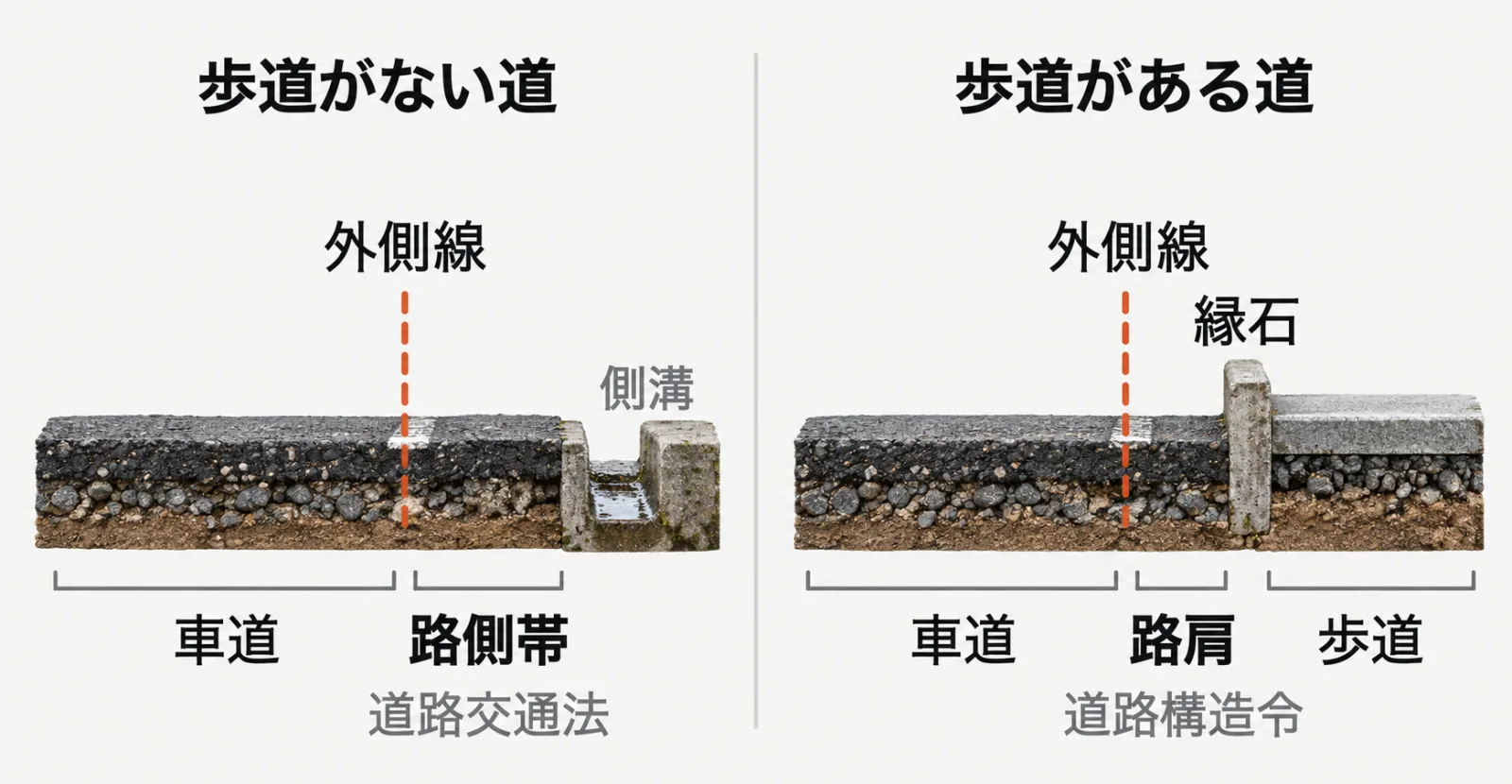
On a road without a pavement, the space outside the white line near the edge is a roadside strip. The term comes from the Road Traffic Act and means a strip for pedestrians (Road Traffic Act Art. 2(1)(iii-4)). Even a line that looks like a plain edge line is legally treated as a roadside strip if it's solid and on a side with no pavement (Order on Road Signs, Lane Lines and Road Markings Art. 7).
On a road with a pavement, the strip between the edge line and the kerb is a shoulder. The term comes from the Road Structure Ordinance and means a margin that protects the road's structure and keeps the carriageway easy to use. Roads in principle have a shoulder next to the carriageway, and the ordinance sets a standard of at least 0.5 m for the left shoulder of ordinary urban roads. A roadside strip on a road without a pavement can also count as a shoulder in terms of road structure. The difference is whether you use the traffic rules (Road Traffic Act) or the road structure rules (Road Structure Ordinance).
Under the Road Traffic Act, cars and motorcycles must use the carriageway where it is separated from a roadside strip, and may not drive in the strip. Bicycles may use a roadside strip on the left side of the road, but at a speed and in a way that doesn't get in pedestrians' way.
There are three kinds of roadside strip line
Roadside strips have three kinds of line, and the parking and stopping rules change with each (Fig. 3).
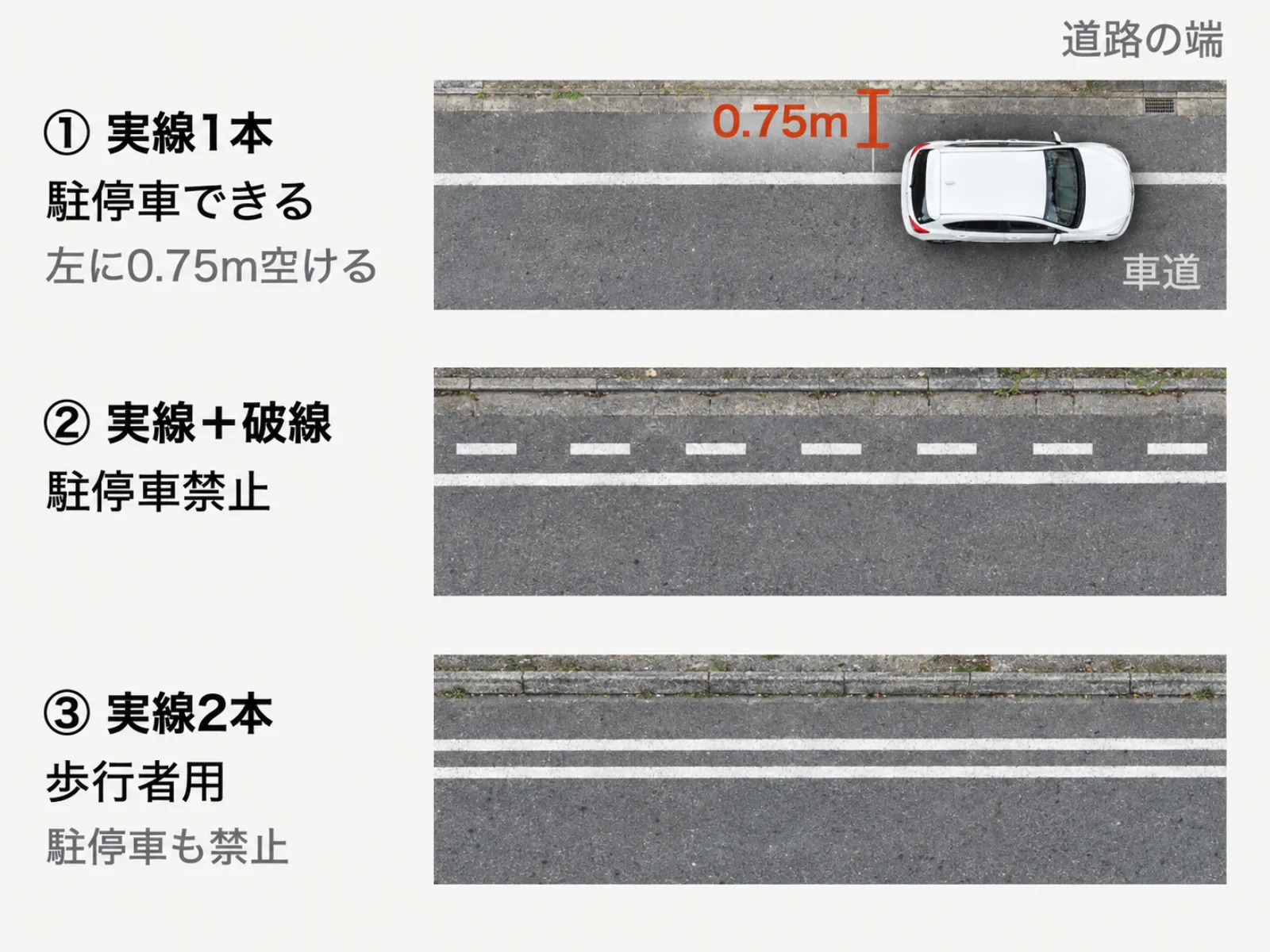
To park in a strip with a single solid line, pull into it and leave 0.75 m on the car's left for pedestrians. Don't enter strips 0.75 m wide or less (Road Traffic Act Enforcement Order Art. 14-6). A strip with a solid and a broken line means no parking or stopping. Two solid lines mark a pedestrian-only strip, where neither parking nor stopping nor cycling is allowed. What the line in the middle of the road means is covered in Yellow lines vs white lines on Japanese roads
What are the posts with reflectors at the edge of the road?
They are delineators. They reflect headlights when it's hard to see at night or in rain, showing drivers how the road bends ahead. Under the national standard, reflectors are white on the left side of the road and orange on the right and on central reservations. On ordinary roads they are at most 40 m apart, with reflectors 50 to 100 cm above the road surface (Source: Delineator Installation Standards).
In snowy regions you see tall poles with a downward-pointing arrow board sticking out. These are fixed delineator poles (arrow vanes), and the tip of the arrow marks where the edge of the carriageway is. They began as markers for snow clearing and now also guide drivers when blizzards make it hard to see ahead (Source: Civil Engineering Research Institute for Cold Region).
What if a gutter cover is broken?
Report broken or rattling gutter covers and blocked channels to that road's manager: the city office for a city road, and the respective managers for national and prefectural roads. If it's immediately dangerous, such as a cover missing and leaving a hole, or a step that nearly made you fall, let them know quickly. Ryugasaki City says that for blocked gutters on city roads, it investigates on receiving a report and cleans them if urgent (Source: Ryugasaki City). How to find the right contact is covered in Who do you contact when you find a hole in the road?
Parking and stopping rules vary with signs and location, so follow the signs and markings on site.
For road users: read next Yellow lines vs white lines on Japanese roads / Who do you contact when you find a hole in the road?
For road managers I am developing MICHIKARTE, a service that lets road users record damage they find with a smartphone and passes it on to road managers.
Last checked: September 27, 2026
References (in Japanese)
- Road Structure Ordinance (e-Gov Law Search)
- Road Traffic Act (e-Gov Law Search)
- Road Traffic Act Enforcement Order (e-Gov Law Search)
- Order on Road Signs, Lane Lines and Road Markings (e-Gov Law Search)
- Ministerial Ordinance setting standards for road structures needed for barrier-free movement (e-Gov Law Search)
- MLIT road consultation office: Traffic safety measures
- Delineator Installation Standards (MLIT)
- Civil Engineering Research Institute for Cold Region: Visibility of fixed delineator poles (arrow vanes) in blizzards (Monthly Report No. 636, 2006)
- Funabashi City: Please help clean road catch basins and gutters
- Ryugasaki City: The gutter is blocked. I'd like it cleaned