What types of asphalt are used on roads? And why some pavement lets water through on purpose
Asphalt that lets water through on purpose soaks rainwater into the pavement so splashing and skidding are less likely. How it differs from the dense-graded asphalt on ordinary roads, drainage vs permeable vs water-retaining pavement, and how it compares with concrete, in cross-sections.
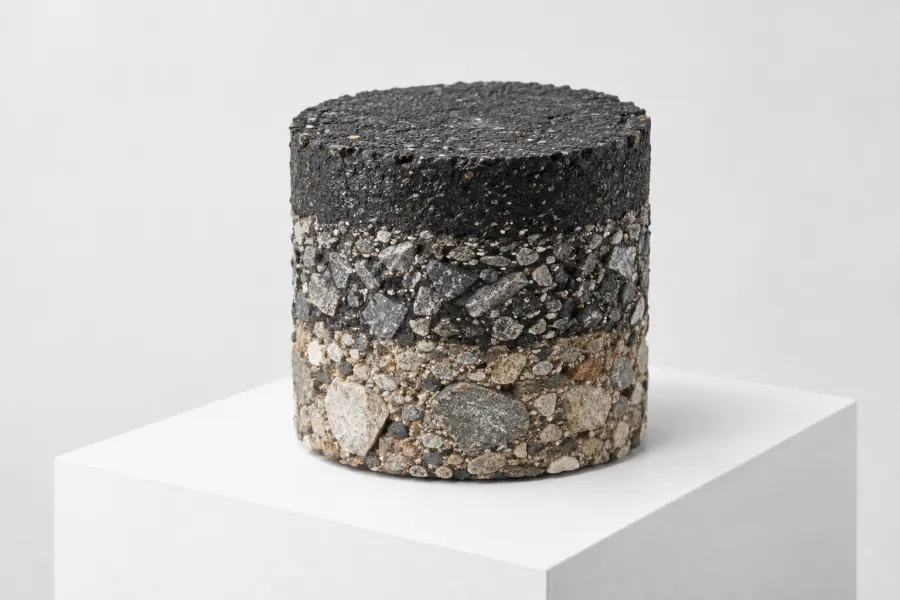
Asphalt that lets water through on purpose is pavement designed not to leave rainwater on the surface. Rain soaks into the gaps between the stones, making splashing less likely, as well as hydroplaning, where tyres ride up on water and the steering stops working. Ordinary road surfaces are dense-graded asphalt, with stones packed tightly together, and rain runs across the surface towards the gutters at the edge.
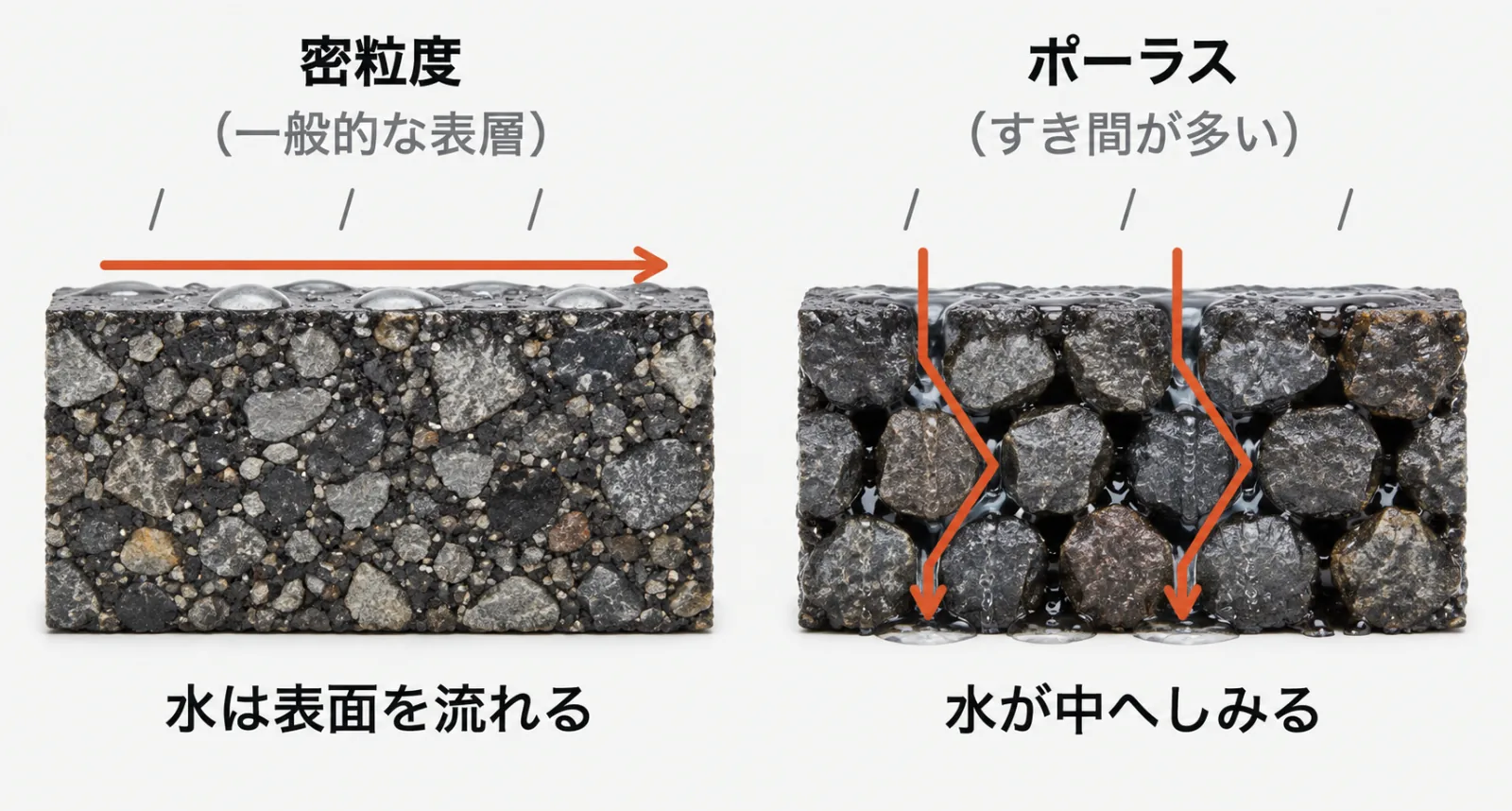
How do asphalt and concrete differ?
Road pavement comes in two main kinds, asphalt and concrete. By road length, concrete makes up only about 4.5% (end of March 2024, calculated from Table 3 of MLIT, Road Statistics Annual Report 2025).
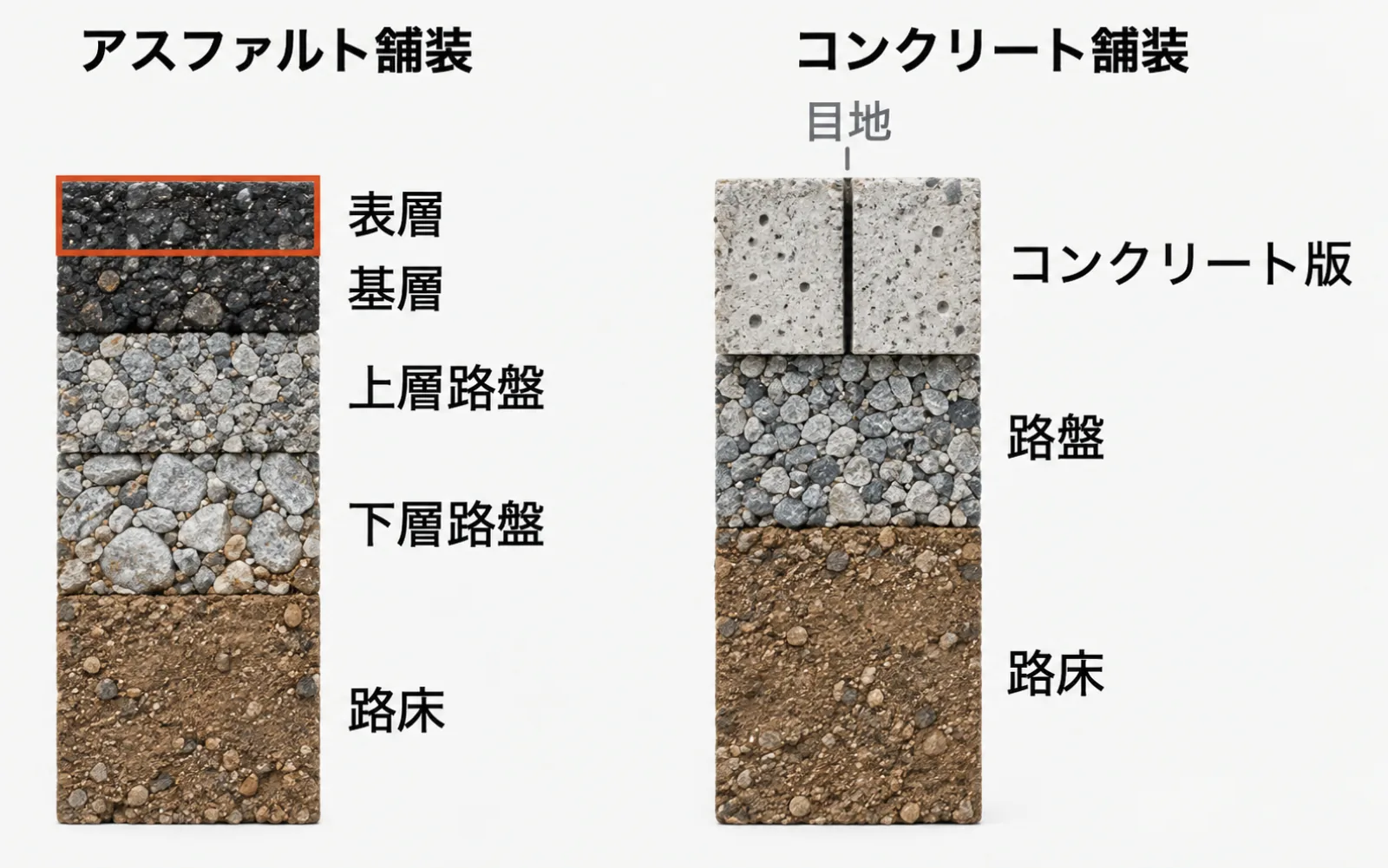
Asphalt pavement sets quickly but is more affected by heat. Concrete pavement takes longer to set but resists wear and is less prone to rutting (dips worn where tyres run) (Source: MLIT road consultation office).
| Asphalt pavement | Concrete pavement | |
|---|---|---|
| Time to set | Quick | Takes time |
| Typical design period | 10 years | 20 years |
| Main uses | Ordinary roads | Roads with many heavy vehicles, tunnels |
The design period is the number of years expected before vehicle loads cause cracking; the table shows the figures the national design standards treat as typical (Source: MLIT, Design standards for road pavement). Where repair work is hard to carry out, as in tunnels, longer-lasting concrete is chosen.
How many layers is a road?
Asphalt pavement has a surface course that vehicles drive on and a binder course beneath it, both made of asphalt, supported below by base courses of crushed stone and similar. At the bottom, the subgrade is the ground the pavement sits on. In the standard cross-section of the national design standards, the surface course is dense-graded asphalt and the binder course is coarse-graded asphalt.
Concrete pavement lays thick concrete slabs on the base, with joints at regular intervals (Fig. 2).
Road asphalt is crushed stone, sand and stone powder bound with asphalt. Its formal name is asphalt mixture, and the industry calls it "gozai". Construction uses hot mix laid warm, and some repair materials can be used at normal temperatures (Source: Japan Asphalt Mixture Association). Of the old asphalt pavement removed in works, 99.5% is recycled (fiscal 2018, MLIT).
What kinds of asphalt are there?
An asphalt mixture's properties change with how stones of different sizes are combined. On roads around you, you mainly see these three.
- Dense-graded: Stones large and small packed with no gaps. Used for the surface of ordinary roads
- Open-graded: Leaves many gaps. Used for anti-skid and permeable pavement
- Porous: Especially many gaps. Used for the surface of drainage pavement and quiet low-noise pavement
The number after a name, as in "dense-graded asphalt mixture (13)", is the size of the largest stone in mm. The F in "13F" means extra stone powder, used mainly in cold regions (Source: Japan Asphalt Mixture Association, Types and features of asphalt mixtures).
What kinds of water-permeable pavement are there?
They split into three by where the water goes: drainage, permeable and water-retaining.
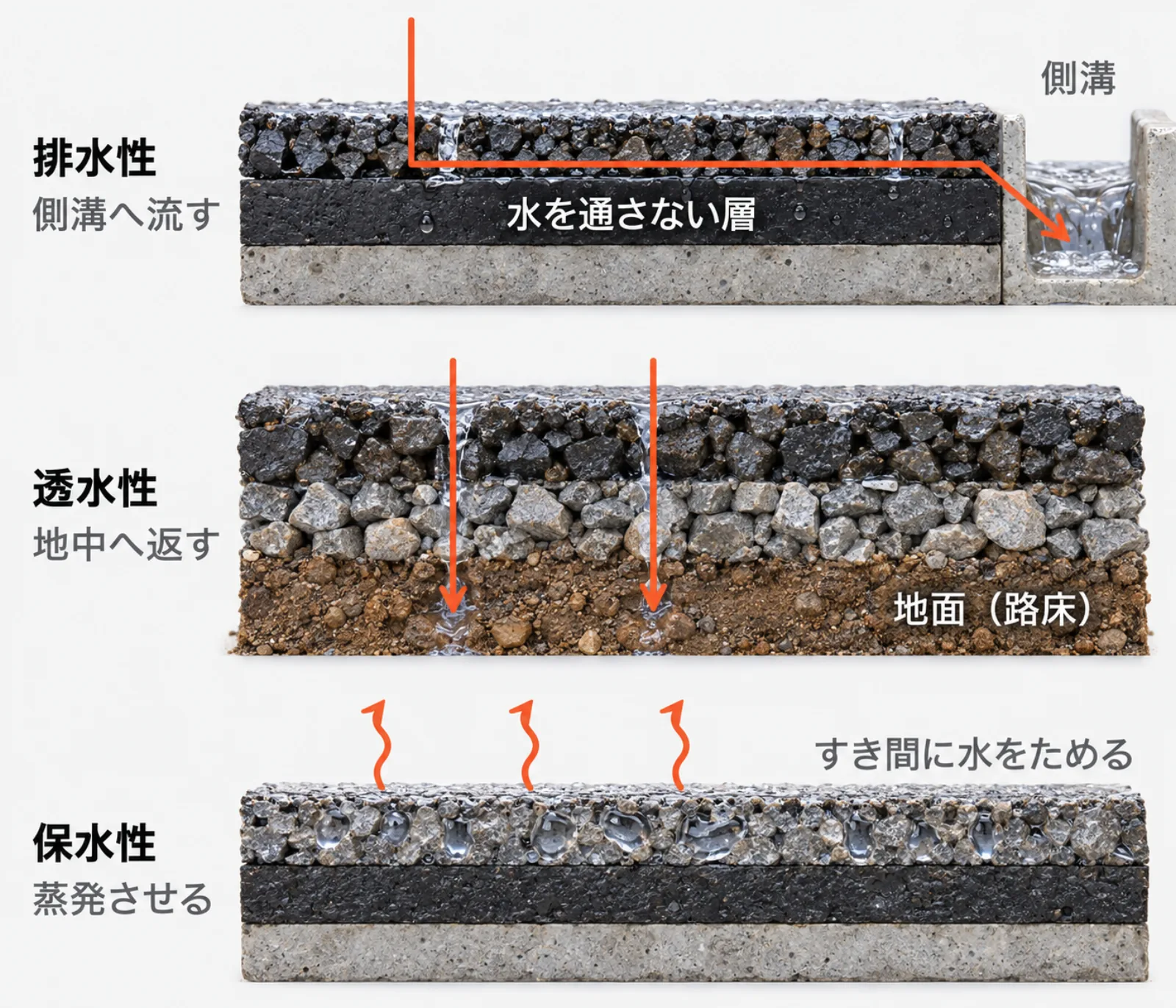
- Drainage pavement: Water that soaks into the surface course flows to the gutter over a waterproof layer beneath it. It also makes traffic quieter.
- Permeable pavement: Lets water through to the ground below the pavement, returning rainwater to the soil and reducing sudden runoff.
- Water-retaining pavement: As water held in its gaps evaporates, it takes heat with it, lowering summer surface temperatures by about 10 to 20°C (Source: Japan Road Contractors Association, Water-retaining pavement).
Tyres riding up on water is called hydroplaning. Besides preventing it, drainage pavement scatters headlight glare less on wet nights, making the road easier to see (Source: Japan Road Contractors Association, Porous asphalt pavement).
When a carriageway is made water-permeable, the standard right after construction is that at least 1,000 ml (300 ml on some road types) soaks in through a 15 cm circle in 15 seconds (Source: MLIT, Technical standards for pavement structure).
Drainage pavement can, however, deteriorate from the binder course below because of the water soaking in. How water relates to pavement damage is explained in Why do potholes form?
What other pavements are there?
Some pavements are designed for particular local problems such as heat, rutting, darkness or ice (Source: Japan Road Contractors Association).
- Heat-shielding pavement: A resin that reflects infrared is coated on the surface, lowering summer daytime surface temperatures by 10°C or more
- Semi-flexible pavement: A special cement grout is soaked into open asphalt so ruts form less easily. Used at intersections, bus terminals, toll booths and the like
- Light-coloured pavement: Pale stones brighten the surface, making places such as tunnels easier to see
- Ice-inhibiting pavement: Anti-icing agents or rubber are mixed in, so slopes and intersections in cold regions freeze less
How to tell them apart in town
Appearance gives only a rough guide. Black with a fine-textured surface is dense-graded; rough with small visible holes is drainage or another open pavement. Whitish with joints at regular intervals is concrete.
They're easier to tell apart in the rain. On sections of drainage pavement, water doesn't pool on the surface as much and cars throw up less spray.
FAQ
Q. Why is the road surface in tunnels whitish?
Because it may be concrete pavement or light-coloured pavement using pale stones. Concrete suits places where repairs are hard to carry out, and light-coloured pavement makes the surface look brighter under the lights.
Q. Why is the carriageway slightly tilted?
To send rainwater to the gutters at the edge of the road. Paved carriageways normally have a sideways tilt (cross slope) of 1.5 to 2% (Road Structure Ordinance Art. 24). On pavement that lets water through, the tilt can be reduced or left out as long as drainage isn't affected.
For road users: read next Why do potholes form? / Yellow lines vs white lines on Japanese roads
For road managers I am developing MICHIKARTE, a service for recording pavement damage with a smartphone and sharing it on a map.
Last checked: September 27, 2026
References (in Japanese)
- MLIT road consultation office: What kinds of pavement are there?
- MLIT: Road Statistics Annual Report 2025, current state of roads, Table 3 summary of actual road length
- MLIT: Chapter 6, Design standards for road pavement
- MLIT: On the technical standards for pavement structure (June 29, 2001)
- MLIT: FY2024 survey of construction by-products, document 4
- e-Gov Law Search: Road Structure Ordinance
- Japan Asphalt Mixture Association: What is asphalt mixture?
- Japan Asphalt Mixture Association: Types and features of asphalt mixtures
- Japan Road Contractors Association: Porous asphalt pavement
- Japan Road Contractors Association: Waterproof drainage pavement
- Japan Road Contractors Association: Water-retaining pavement
- Japan Road Contractors Association: Heat-shielding pavement
- Japan Road Contractors Association: Semi-flexible pavement
- Japan Road Contractors Association: Light-coloured pavement
- Japan Road Contractors Association: Ice-inhibiting pavement