How do you read distance markers on Japan's national highways? The numbered posts by the road, and the small markers every 100 m
Along Japan's national highways stand distance markers (chitenhyo) showing the distance from the route's starting point. The difference between the 1 km and 100 m markers, how to read the numbers, and which side of the road they stand on, based on the national installation guidelines.
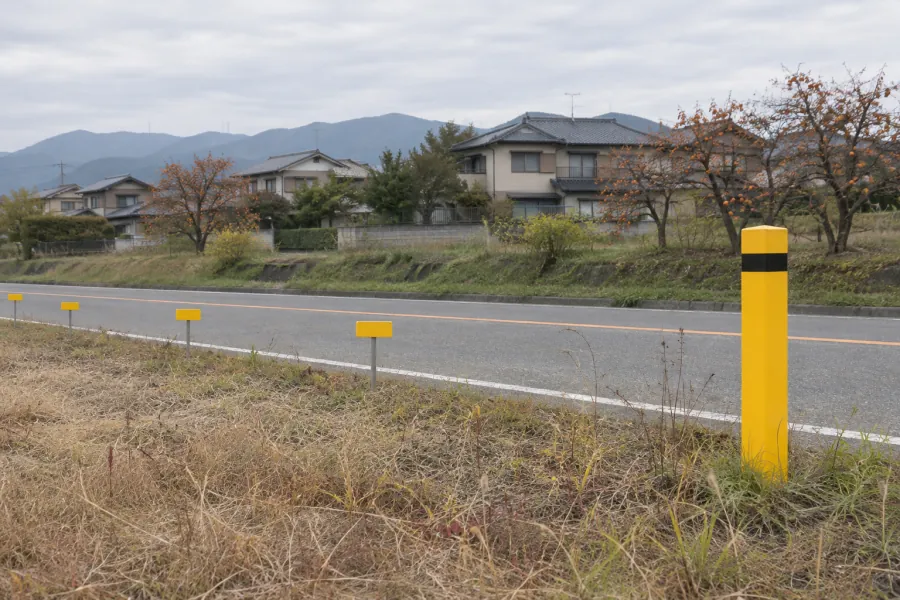
Many people know the kilometer posts on expressways, but fewer know that ordinary national highways also have markers showing distance along the roadside. These markers serve as reference points when describing a location or recording inspections.
This article explains the types of distance markers on national highways (called "chitenhyo", or point markers, in the national guidelines) and how to read their numbers. Expressway kilometer posts are covered in "What is an expressway kilometer post?".
What is a national highway distance marker?
A national highway distance marker shows, at the roadside, the distance from the route's starting point. The Road Act lists "mileposts" (ritei-hyo) as one of the road's accessories (source: Road Act, Article 2, Paragraph 2).
The national "Guidelines for Installing Point Markers on Class 1 National Highways" call these markers "chitenhyo" and define two types (source: Ministry of Construction Road Bureau notice, "Installation of Point Markers on Class 1 National Highways", 10 March 1964).
- Kilometer markers (kiro-hyo): placed every 1 km from the starting point
- Hundred-metre markers (hyaku-meetoru-hyo): placed every 100 m between kilometer markers
The 1 km markers and the 100 m markers
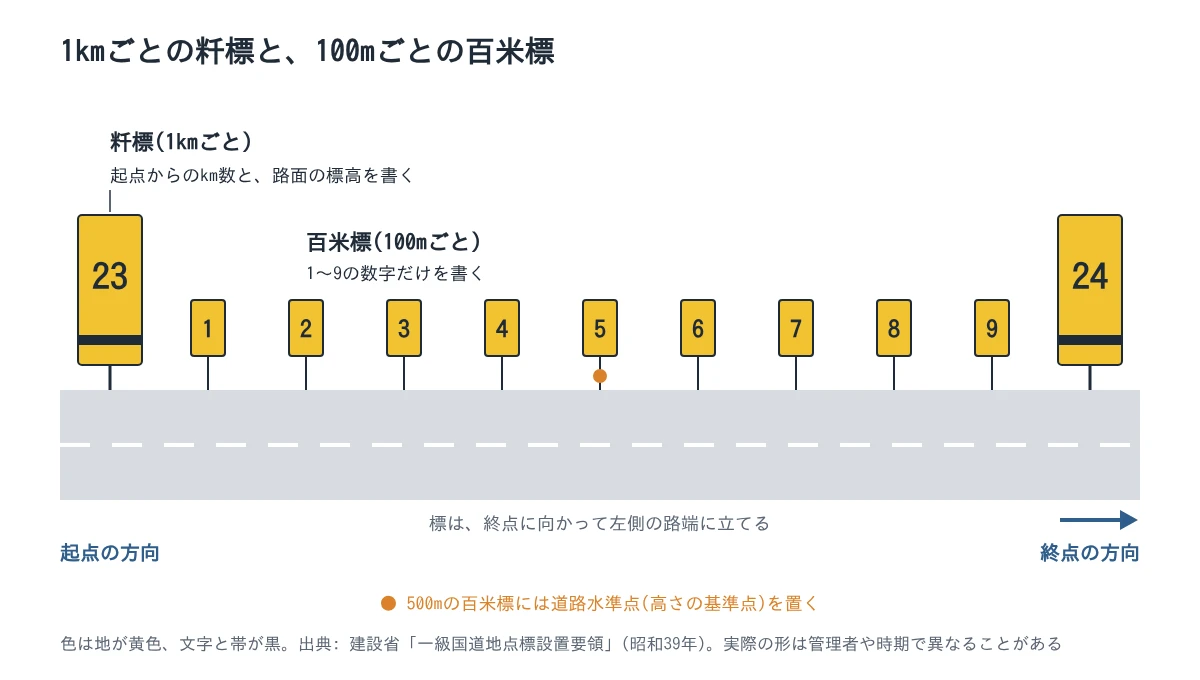
The guidelines set out each marker as follows.
- Kilometer markers: show the distance from the starting point (km) and the elevation of the road surface
- Hundred-metre markers: show only a number from 1 to 9, giving how many hundred metres past the kilometer marker the spot is
- The 500 m marker: carries a reference point for road height (a road benchmark)
- Colour: yellow background, black lettering and band
- Material: durable, such as concrete or metal
(Source: Guidelines for Installing Point Markers on Class 1 National Highways)
How do you read the numbers?
A hundred-metre marker only has a single digit such as "4", so it is read together with the kilometer marker before it.
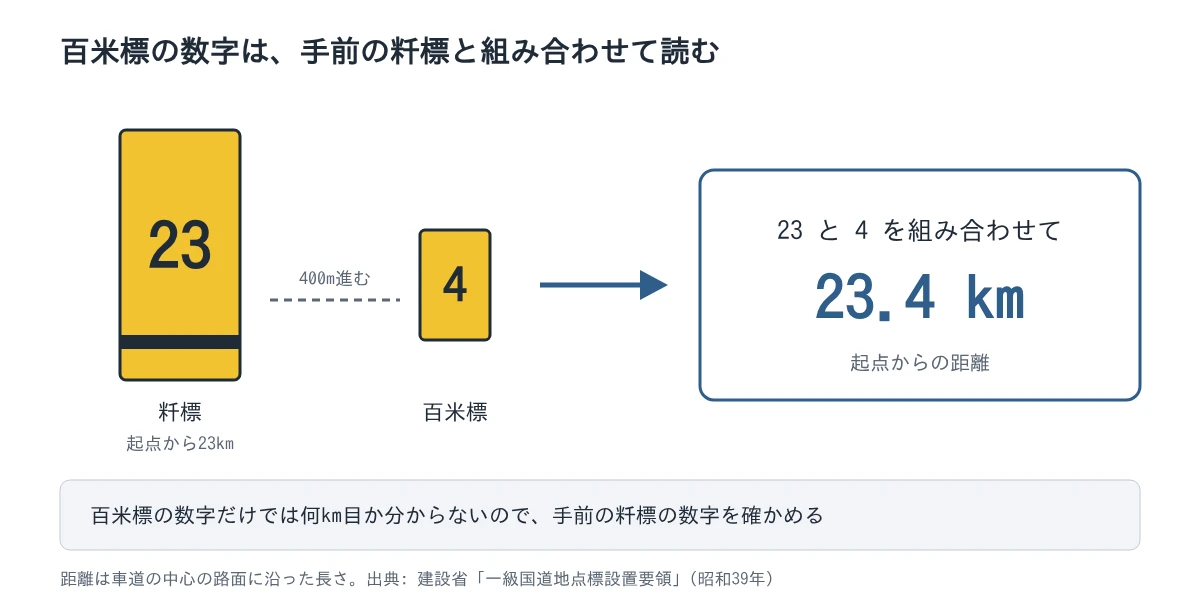
For example, if you pass a kilometer marker reading "23" and then a hundred-metre marker reading "4", that spot is 23.4 km from the starting point.
Distance is measured along the road surface at the centre of the carriageway (source: Guidelines for Installing Point Markers). On roads with many curves or slopes, it will not match the straight-line distance on a map.
Which side of the road are they on?
The guidelines place the markers on the roadside "on the left facing the end point of the route". Where the two directions are separated, they go on the left of the outbound carriageway (source: Guidelines for Installing Point Markers).
So drivers heading towards the end point see them on their left, while drivers going the other way see them across the opposite lanes. Where a marker can't go in its set place because of a driveway or junction, it may be moved by up to about 20 m.
Can they be used to describe a location?
If you know the number on a distance marker, you can describe a location without an address, such as "around 23.4 km on National Route X". This helps when reporting road damage to the road manager. How to find who to report to is covered in "How to find the road manager".
These guidelines were written in 1964 for what were then "Class 1 national highways". The actual shape and size of markers can vary by road manager and by when they were installed. Some are small plates attached to guardrails.
For national highway distance markers, the government publishes the latitude and longitude every 1 km. How to look them up is explained in "How to find a kilometer post's latitude and longitude".
FAQ
Q. Do prefectural and municipal roads have distance markers too?
Some road managers install them, but the rules and appearance vary by manager. This article covers national highway markers under the national guidelines.
Q. Where is the starting point?
It is set for each route. The start and end points of national highways can be checked in government materials or the road manager's materials.
Q. How do they differ from expressway kilometer posts?
Both show the distance from the starting point. On expressways, the 100 m markers often show a decimal such as "46.8", whereas national highway hundred-metre markers show only a single digit.
To use kilometer posts on a map Data listing expressway kilometer posts with latitude and longitude every 100 m is available. → Kilometer Post Data
Last checked: 23 November 2026