What are the red-and-white arrows above roads in snowy Japan? Why they hang high and point down
The red-and-white arrows above roads in snowy parts of Japan are "yabane" (fixed delineator posts), and the spot right below each arrow tip is the edge of the road hidden under snow. Why they are mounted over 5 m up, where the red and white comes from, how snowplows use them, and how to drive in a blizzard.
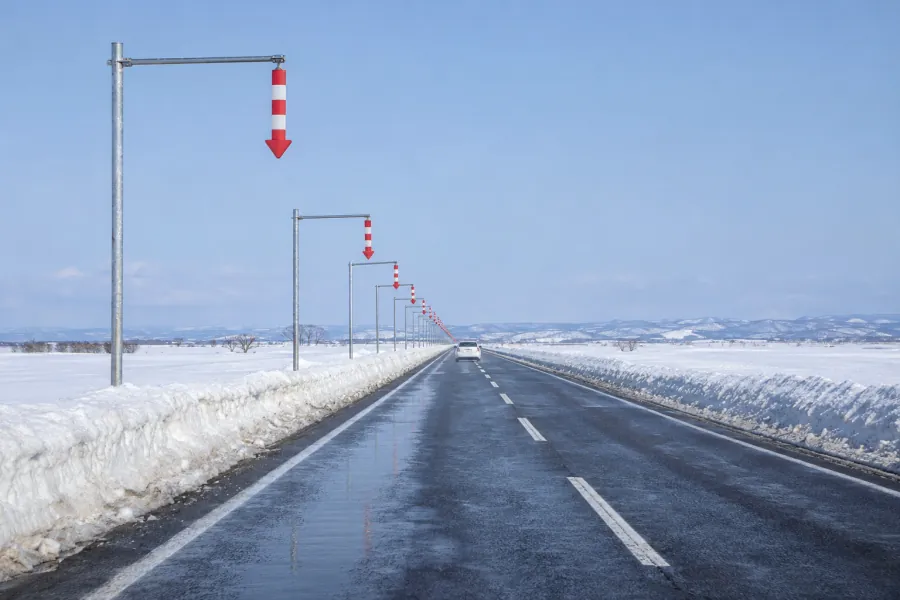
The red-and-white arrows above roads in snowy parts of Japan are called "yabane" (arrow feathers), and the spot right below each arrow tip is the edge of the road. Even when snow hides the white lines and the shoulder, following the arrow tips tells you where the road ends. When a blizzard makes it hard to see ahead, slow down and keep inside the line of arrow tips.
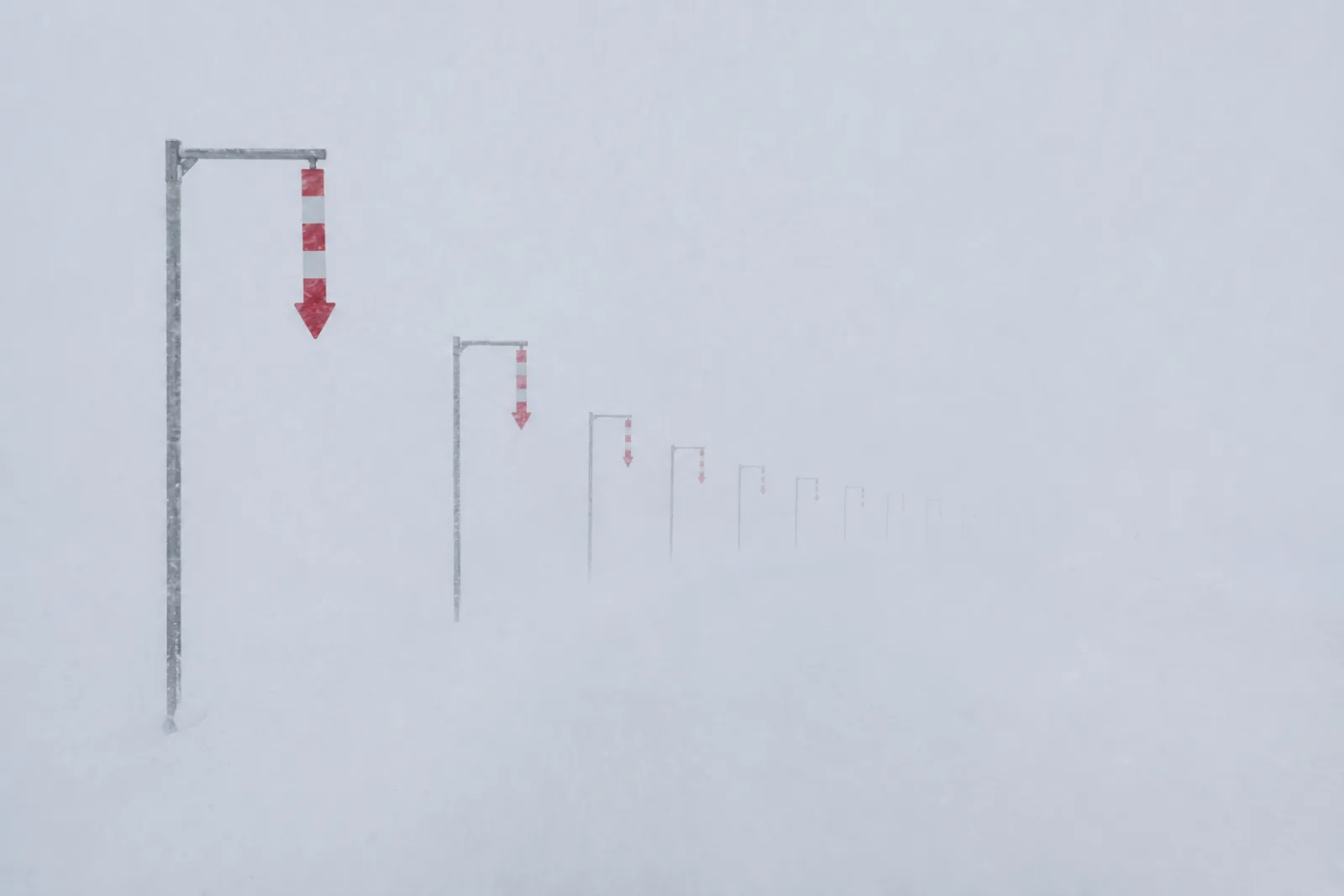
What do the arrows point at?
The official name is "fixed delineator post" (koteishiki shisen yudo chu). The Road Blizzard Countermeasures Manual by the Civil Engineering Research Institute for Cold Region (CERI) describes them as posts placed one after another along the road edge to make the road easier to see in snow and blizzards, and to show the width to be cleared of snow (source: CERI Road Blizzard Countermeasures Manual, Part 4). It is used as the basic reference for blizzard measures on national roads in Hokkaido.
On ordinary sections the arrow points at the white line along the road edge (the outer line). Where there is a kerb, it points at the face of the kerb. The post itself stands outside the road, and an arm reaches out over the road so that the arrow hangs right above the white line.
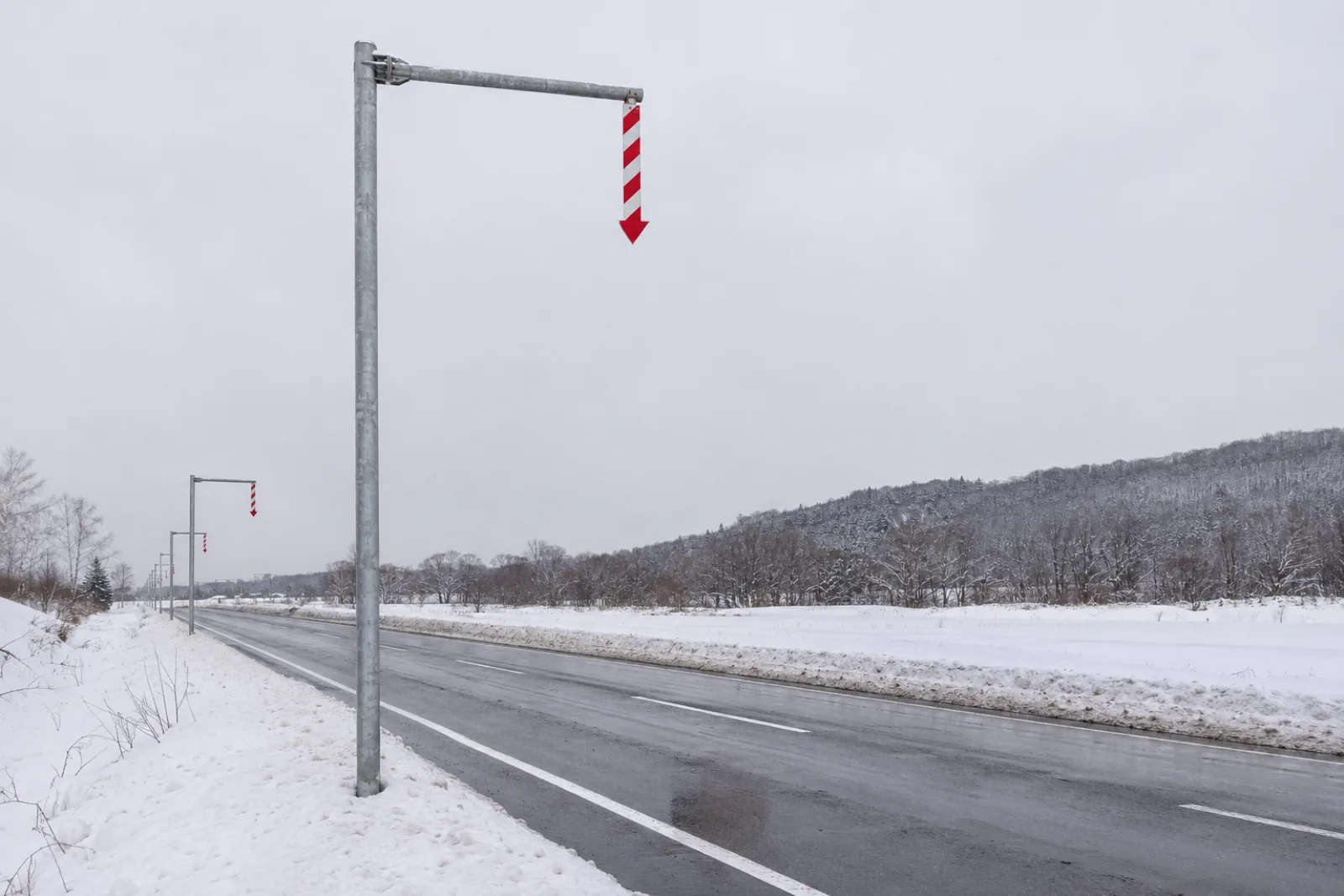
The standard spacing is 80 m or less, and it gets closer on tighter curves. It was chosen so that two or three markers stay in view, showing which way the road bends, even in a blizzard where you can see only about 100 m (the visibility). Some roads have low posts with reflectors (delineators) along the edge instead. The arrows do the same job, so as a rule the two are not used on the same section.
Why do they hang high and point down?
The arrows are mounted more than 5 m above the road, above the clearance kept free for traffic. The standard arrow board is 1,200 mm long and 150 mm wide (350 mm at the widest), far larger than the reflector on a low delineator post (70 to 100 mm across, 90 cm high) (Road Blizzard Countermeasures Manual).
Up high, the arrows sit above the layer of snow that strong wind lifts off the ground (ground blizzard). Even when everything in front of the windscreen is a white blur, the arrows remain easy to see.
They point down because the tip marks where the road edge is. Even on sections where the shape and colour are changed to suit the scenery, the pointer at the bottom that marks the white line or shoulder stays.
Why red and white?
The first coloured snow poles (striped poles set along the road edge) used in Hokkaido, in 1946, were red and white, and the arrows took over that colour. The commentary on Japan's delineator installation standard also says that snow poles in snowy areas should have red-and-white zebra stripes (Road Blizzard Countermeasures Manual).
Against white snow, red catches the eye more than orange or yellow. On mountain roads in the snowless season, though, the arrows can stand out too much, so on sections where the scenery matters, square arrows in yellow and navy, or posts painted dark brown, are also used.
There are also arrows that light up, for blizzards at night. But the arrow part costs more than ten times as much as an unlit one, and in a moderate blizzard the difference in visibility is small, so unlit arrows are the norm.
What do they mean for snowplows?
The arrows were introduced to make snowplow work faster and more efficient. Snowplows clear snow right up to the full width of the road while watching for an edge hidden under snow. In interviews with snow-clearing contractors in 2003, operators said they rely on the arrows when clearing at night or in blizzards, and use them as a guide when clearing right up to the edge of the road (Road Blizzard Countermeasures Manual).
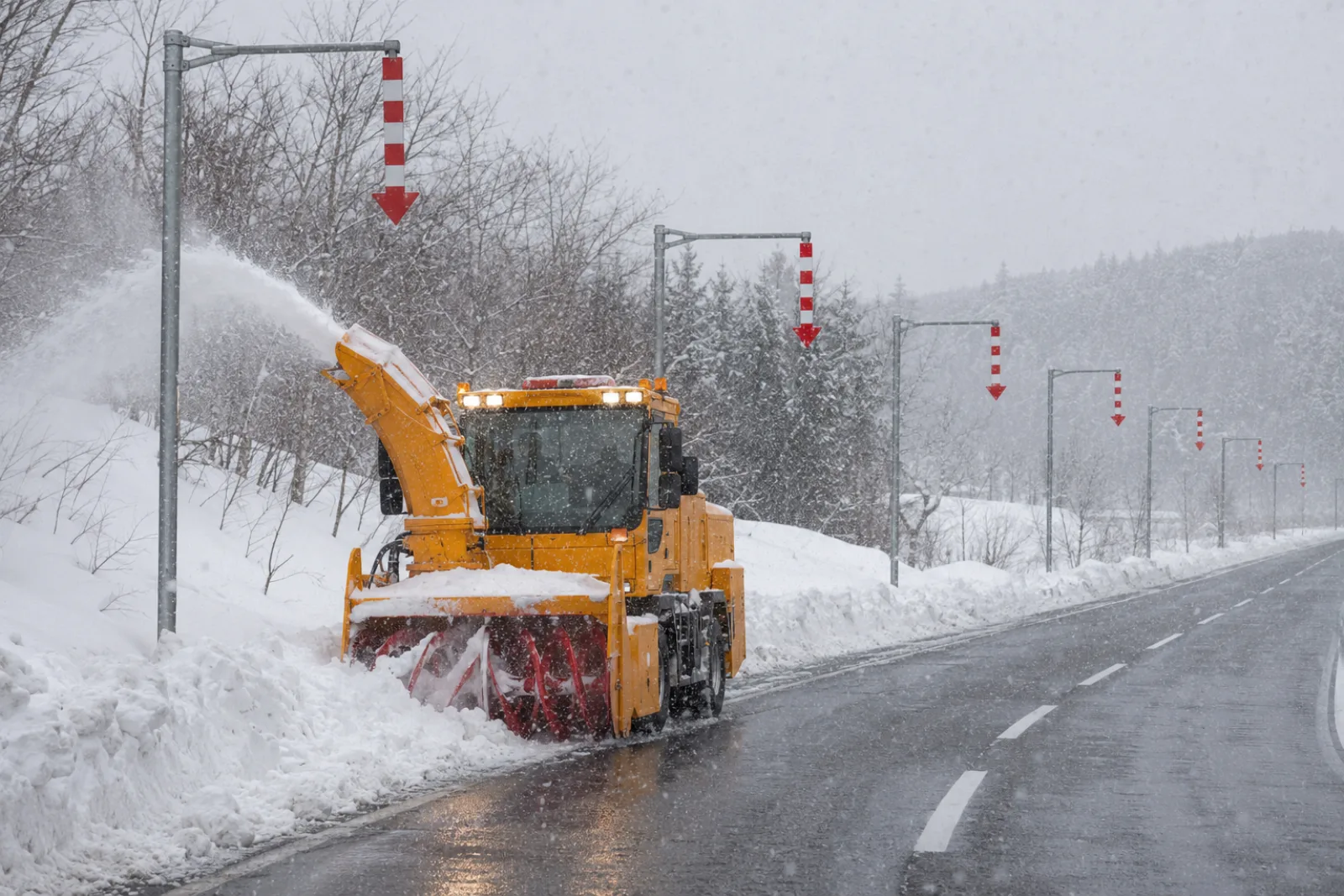
Still, the arrows only help where they stand, and putting them along every road takes money and labour. CERI is developing a device that shines a light from above a snowplow's cab onto the white line ahead to show where it is (source: CERI, Yamazaki: "Development of a line-of-sight guidance device for snowplow operators using directional lighting and GNSS"). Snowplow operators also watch for roadside signs that mark where snow must not be thrown; see Where can't a snowplow throw snow?.
Which roads have them?
Under the manual's selection guide, the arrows go on sections where snow is deep (60 cm or more in a once-in-ten-years snowfall) and where snowplows cut back the snowbanks at the road edge or clear the pavement. Low delineator posts would get in the way of that work. Where extendable posts or snow poles will do, those are chosen first.
In built-up areas lined with houses, pavements are cleared with small snowplows, so the arrows are not needed there. And on roads with continuous lighting, lit arrows are not used even where night blizzards are severe, because the lights themselves guide drivers through the blizzard.
How should you drive when a blizzard blocks your view?
When visibility drops below 100 m and there is no car ahead, drivers have been found to watch the arrows and other delineators to check where the road edge is (Road Blizzard Countermeasures Manual). If you follow only the tail lights of the car in front, you may run into it when it stops. Keep your eyes on the arrow tips and leave a wide gap.
NEXCO Central asks drivers in blizzards and ground blizzards to turn on their headlights and also switch on their hazard lights so that other vehicles can see where they are. Slow down as soon as it starts to get hard to see (source: NEXCO Central Winter Snow Driving Guide).
Below 30 m of visibility, driving becomes almost impossible, and one approach is to close the road at 50 m or less (Road Blizzard Countermeasures Manual). If the weather looks likely to get so bad that you can't see the next arrow, consider changing your departure time, or stopping early somewhere safe to wait it out.
Read next When should you switch to studless winter tyres? The temperature at which roads start to freeze / Why do bridges freeze before the rest of the road? Which days to watch, and why you slow down before the bridge
For road managers I run MICHIKARTE, a service that lets road users record damage they find with a smartphone and passes it on to road managers.
Last checked: 18 November 2026
References (in Japanese)
- Civil Engineering Research Institute for Cold Region, PWRI: "Road Blizzard Countermeasures Manual (2011 revision), Part 4: Other blizzard countermeasure facilities"
- Yamazaki Takashi (CERI): "Development of a line-of-sight guidance device for snowplow operators using directional lighting and GNSS", 69th (FY2025) Hokkaido Development Technology Research Conference
- NEXCO Central: "Winter Snow Driving Guide"