Why do bridges freeze before the rest of the road? Which days to watch, and why you slow down before the bridge
A bridge gets no heat from the ground and is cooled from above and below, so it can be icy on mornings when the roads around it are not. The days when this is most likely, why you slow down before the bridge, what road managers do, and how de-icing salt affects bridges.
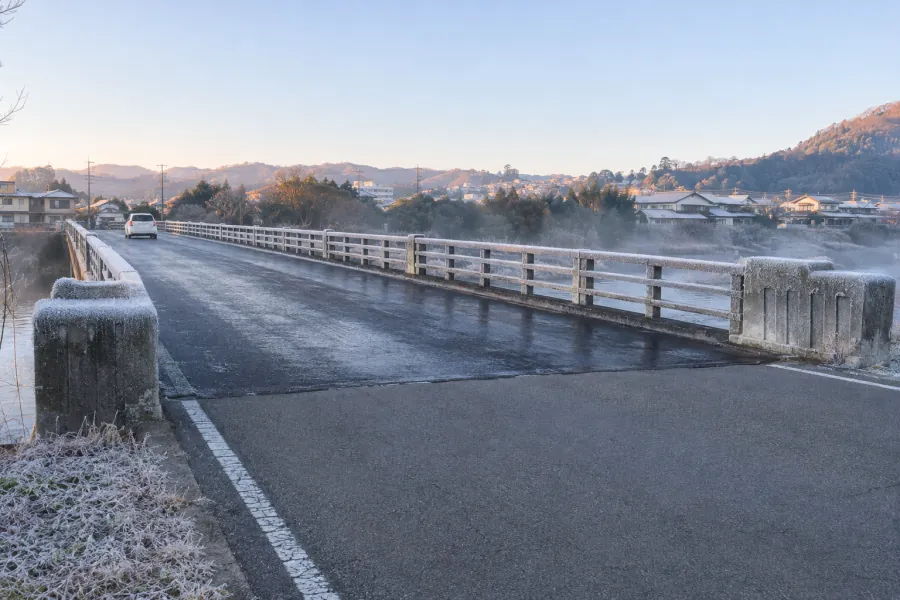
A bridge gets no heat from the ground and is cooled from both above and below, so it can be icy on mornings when the roads around it are not. Icy road surfaces look black, as if they were just wet, and you can't tell the difference while driving. On winter mornings and nights, slow down before you reach a bridge.
Why do bridges freeze first?
An ordinary road has ground beneath the pavement. Even when the surface cools at night, heat stored in the ground rises from below, so it cools slowly. Under a bridge deck there is only air, and no heat from the ground reaches it.
On clear nights, heat escapes from the road surface into the sky (radiative cooling). Observations on a real bridge showed that, when the wind is weak, the surface temperature of a bridge deck is mainly set by this radiation to the sky and by heat conduction through the pavement (source: Watanabe and Fukuhara, Proceedings of Hydraulic Engineering vol. 39). Wind passes under a bridge, so it is cooled from below as well. Snow that falls on it stays unmelted and freezes when the night turns cold (source: Ibaraki Prefecture Civil Engineering Department).
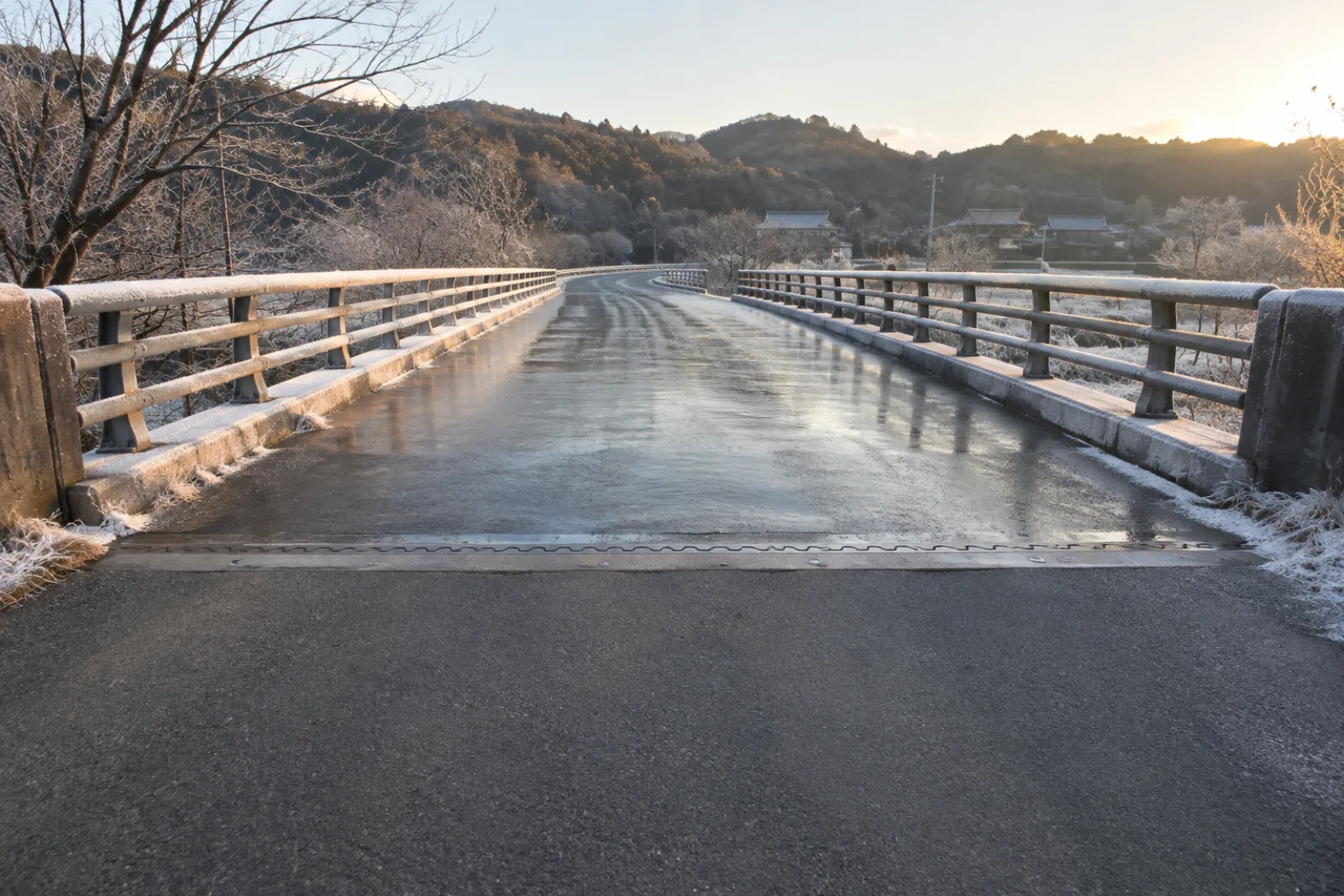
Among bridges, steel bridges have been reported to freeze more readily than concrete ones.
On which days is ice most likely?
Ice is most likely from night into morning when the sky is clear and the wind is light. The road can freeze even when the air is above 0°C. JAF advises watching for ice once the outside temperature drops to 3°C or below (source: JAF Mate Online).
Moisture tends to settle on bridges, and when it freezes it forms a thin film of ice. Thin ice lets the black of the asphalt show through, so the road looks merely wet. This is black ice.
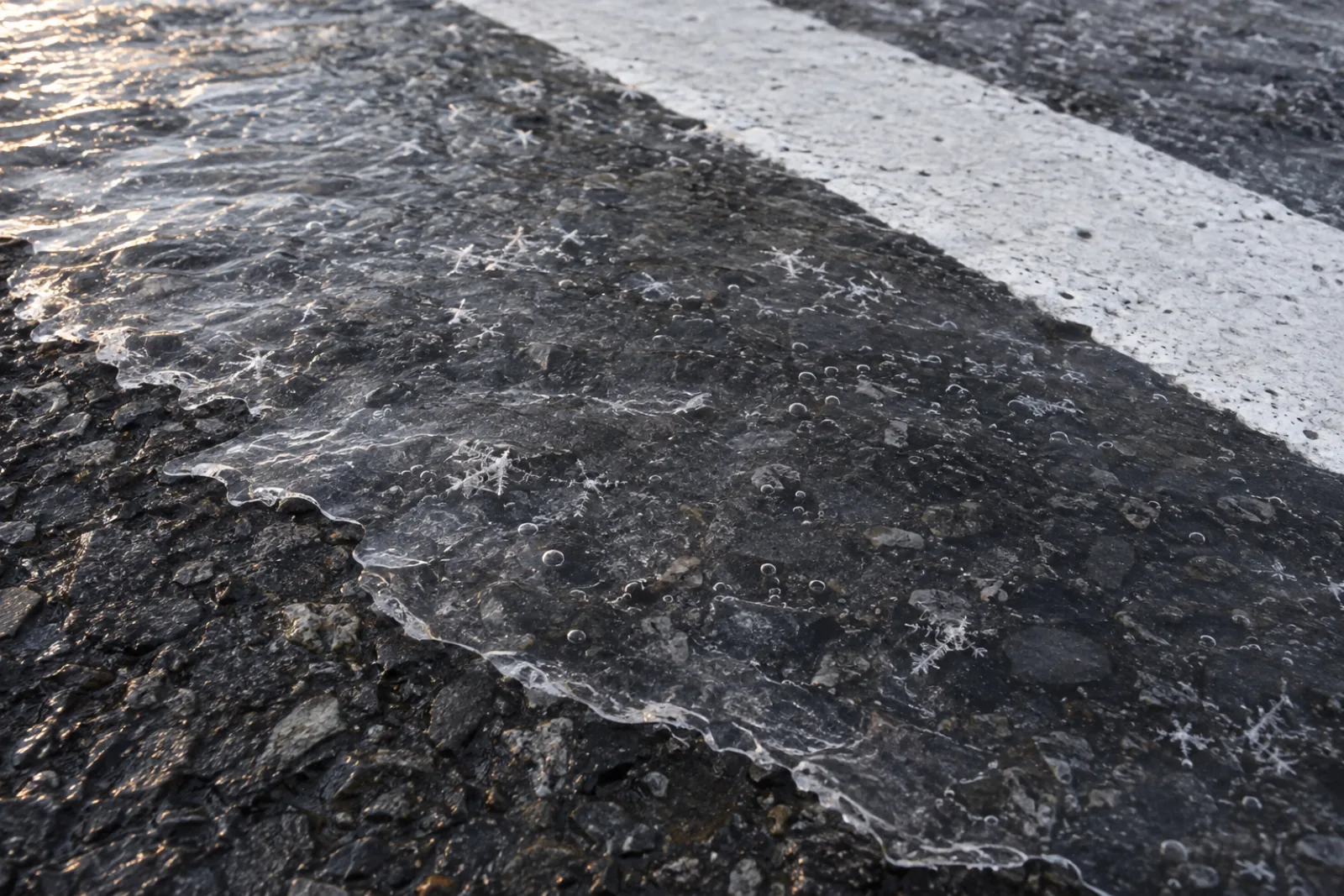
NEXCO Central also says bridges and tunnel entrances and exits are colder than other places and slippery, and warns drivers not to relax just because the road looks black (source: NEXCO Central: driving on expressways in winter).
Why slow down before the bridge?
Braking or steering on an icy surface makes the tyres slide. Once you are on the bridge, you can no longer slow down safely. NEXCO Central asks drivers to slow down well before they reach a bridge or a tunnel entrance or exit.
On the bridge, keep to the following (JAF Mate Online).
- No sudden braking or steering
- Keep at least twice the following distance you would on a dry road
- On downhill stretches, use engine braking rather than the foot brake
Even studless winter tyres can slide on ice.
What do road managers do?
On nights when ice is likely, road managers spread de-icing agent. Some roads keep de-icing agent near bridges so it can be spread quickly (Ibaraki Prefecture Civil Engineering Department). What de-icing agent is made of, and who spreads it and when, is covered in What is the white powder spread on roads in winter?
On expressways in snowy areas, warning signs stand at slippery spots, and some places have road heating that warms the surface (NEXCO Central).
Does de-icing salt affect bridges?
Yes. The de-icing agent spread on national roads is mainly sodium chloride (salt). When salt soaks into concrete, the steel bars inside rust, and cracks and rust stains appear. MLIT names salt spread on roads as a de-icing agent as a cause of salt damage alongside salt from the sea, and has set inspection guidelines for salt damage to concrete bridges (source: MLIT: Guidelines for special inspection of salt damage to concrete bridges (draft)).
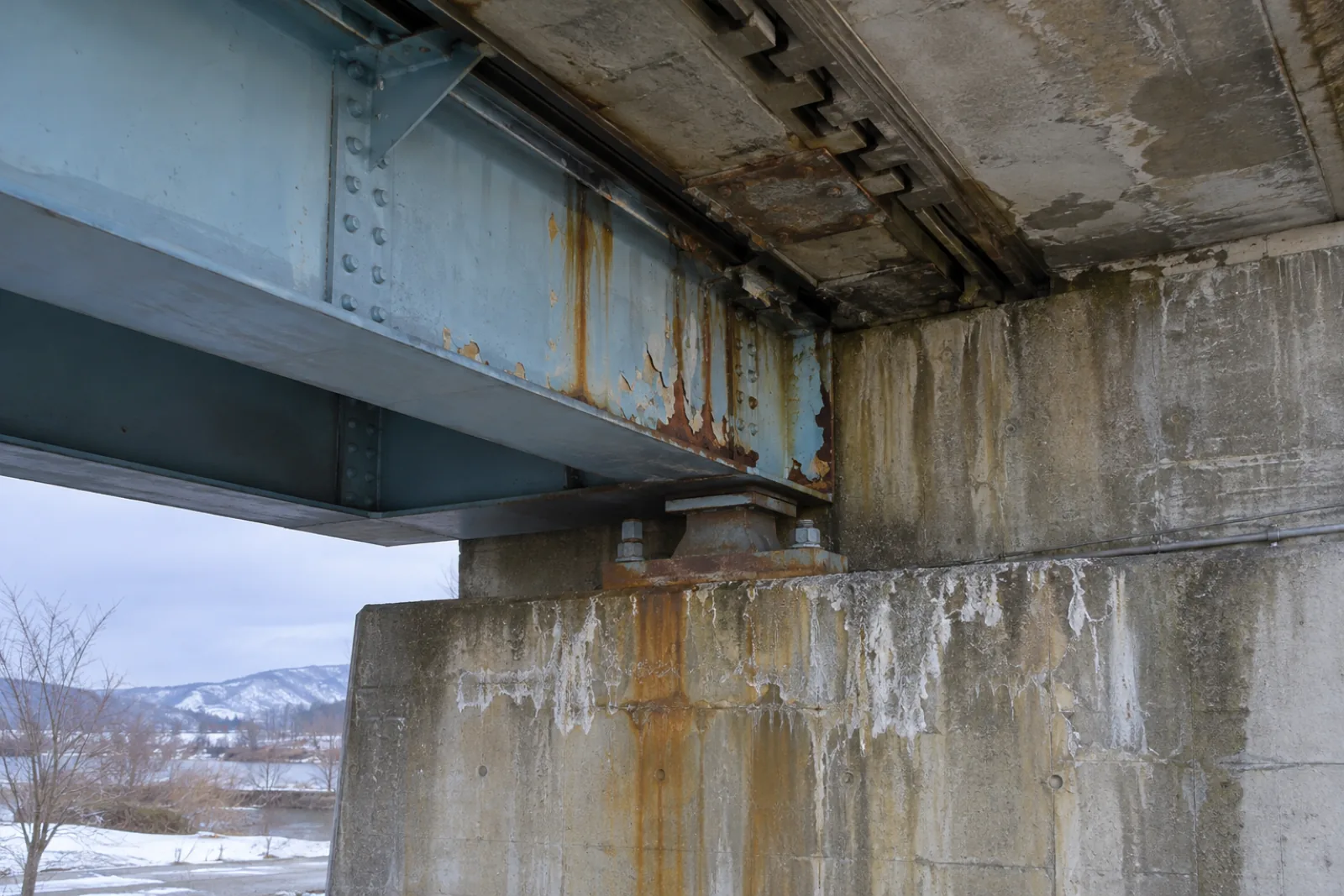
Salty water from the road surface tends to leak through the joints (expansion joints) onto the girder ends, and damage such as cracks and rusting steel bars tends to progress further at the girder ends than in the middle. Washing bridges to remove the salt is also being considered (source: MLIT Chubu Regional Development Bureau).
Read next What is the white powder spread on roads in winter? Does it rust your car? / Why do potholes form? And why there are more in early spring than in the coldest month
For road managers I run MICHIKARTE, a service that lets road users record damage they find with a smartphone and passes it on to road managers.
Last checked: 14 November 2026
References (in Japanese)
- Watanabe and Fukuhara: "Heat and moisture transfer between bridge road and atmosphere, and road surface freezing", Proceedings of Hydraulic Engineering vol. 39 (1995)
- Ibaraki Prefecture Civil Engineering Department: "Beware of icy roads in winter"
- JAF Mate Online: "Protecting yourself from black ice before winter driving"
- NEXCO Central: "Driving on expressways in winter"
- MLIT Road Bureau: "Guidelines for special inspection of salt damage to concrete bridges (draft)"
- MLIT Chubu Regional Development Bureau: "Bridge washing methods based on analysis of bridge damage trends"