Can published AI models be used for road inspection? Why evaluation numbers don't always carry over to the field
Published AI models can be used for road inspection once you check four things: the license, the evaluation conditions, the input requirements and the weak spots. Why the weights are published, and how to read an evaluation, using a pothole model as the example.
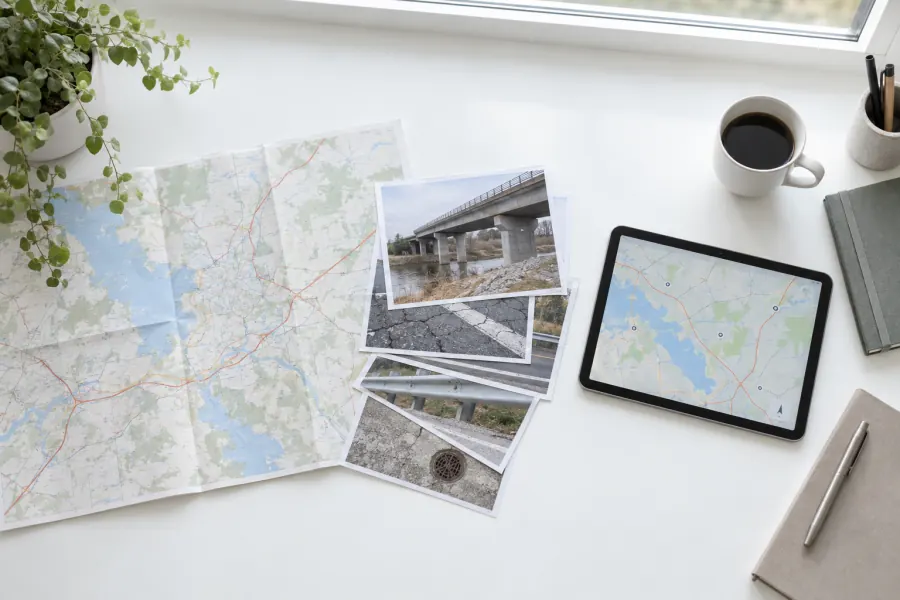
Published AI models can be used for road inspection too. Before you use one, check four things in the publisher's documentation: the license, the evaluation conditions, the input requirements and the weak spots. The evaluation numbers a publisher gives describe performance on the images used for evaluation, not on images taken at your site.
Why publish AI model weights?
Weights are the data that holds what an AI model has learned. With the weights, you can run the same model yourself or retrain it on your own images.
Infra Intelligence's Model Lab publishes the weights of detection models that find road damage and signs. The more people use technology that saves inspection work, the sooner its weak points come to light, and the more people retrain it. Alongside the weights go three things: instructions for use, evaluation results, and the sources of the training data.
Japan's AI Guidelines for Business from the Ministry of Internal Affairs and Communications and the Ministry of Economy, Trade and Industry list, among developers' responsibilities, documenting how data was collected, how annotation (drawing ground-truth boxes and labels) was done and which algorithms were used, in a form third parties can check as far as possible (Source: MIC and METI).
What to check in the license
For a published model, looking only at the license of the weights and code is not enough. The base model and the training data each come with their own terms. For Pothole RF-DETR Nano, the Model Lab model that finds potholes, they are:
| What to check | For Pothole RF-DETR Nano | Where to look |
|---|---|---|
| Weights and code | Apache-2.0 | LICENSE and NOTICE in the distribution |
| Base model | RF-DETR Nano (public weights pre-trained on COCO) | The base model's publisher |
| Training data | 195 images selected from RDD2022 and Roboflow Universe (both CC BY 4.0) | Each dataset's publisher |
Apache-2.0 allows use, modification and redistribution, including commercially. When redistributing, include a copy of the license, note changes in any files you modified, and keep the original copyright notices and NOTICE file. It grants no permission to use trademarks, and the distribution is provided "as is" without warranty (Source: Apache License, Version 2.0).
For the base model RF-DETR, the weights for some sizes, including Nano, are Apache-2.0, while other sizes such as XL carry a different license, PML 1.0 (Source: roboflow/rf-detr). Models with the same name can have different terms by size, so check the size you use.
How to read the training data's terms
CC BY 4.0 data may be copied, redistributed and modified, including for profit. The conditions are to give appropriate credit, link to the license and indicate any changes. The license page also notes that other rights, such as publicity and portrait rights, may limit how material is used (Source: Creative Commons). Road images can show people's faces and number plates, so this matters when redistributing training images.
Pre-training data can have layered terms too. For COCO, the annotations (ground-truth boxes and labels) are CC BY 4.0, but the COCO consortium does not own the copyright of the images, whose use is governed by Flickr's terms of use (Source: COCO).
How to read the evaluation numbers
Detection models are mainly evaluated with three numbers (Source: Ultralytics Docs).
- Precision: the share of the model's "found" results that were correct. Higher means fewer false detections
- Recall: the share of real objects that were detected. Higher means fewer misses
- AP50: a single number summarising the trade-off between precision and recall, counting a detection as correct when its overlap with the ground-truth box (IoU) is 0.5 or more
Pothole RF-DETR Nano was evaluated as follows. Precision and recall are for candidates with a score (confidence, 0 to 1) of 0.45 or more treated as detections.
| Metric | Validation (29 images, 42 holes) | Test (29 images, 44 holes) |
|---|---|---|
| AP50 | 0.728 | 0.737 |
| Precision | 0.79 | 0.80 |
| Recall | 0.62 | 0.73 |
A test recall of 0.73 means it found about 70% of the 44 holes in the 29 images. A precision of 0.80 means 80% of the boxes it reported as holes really were holes.
There are three reasons, also given on the model's page, why these numbers may not carry over to the field.
- Only 29 images each were used for evaluation, so the numbers swing widely
- The threshold (0.45) was chosen after seeing the test results, so the test figures may be better than real performance
- The evaluation images came from the same public datasets as the training images, and performance while actually driving has not been measured yet
The AI Guidelines for Business also list, among things developers should tell providers, that prediction performance may change significantly after deployment and may fall short of the expected accuracy (MIC and METI). When reading an evaluation table, read how many images, and what kind, alongside the numbers.
What to check in the input requirements
Even among "detection models", the image format they accept and the post-processing of their output differ from model to model. If you feed images with different pre-processing from training, you won't get the evaluated performance.
Pothole RF-DETR Nano takes 384 × 384 pixel colour images (RGB). The original image is stretched to a square, changing its aspect ratio. It outputs up to 300 candidates per image, and no merging of duplicate candidates (NMS) is needed.
The Model Lab model for no-snow-throwing signs takes 1280 × 736 pixel images. Distant signs are detected in a part of the frame cut out without shrinking, and close signs in the whole frame shrunk to a third, running the same model twice. Merging duplicates (NMS) has to be built in by the user.
In the publisher's documentation, check five things: image size, colour order (RGB or BGR), how the image is resized, the threshold, and how to read the output. If the publisher shows results on particular images, compare whether your own pipeline gives the same boxes and scores.
How to check the weak spots
Conditions the publisher says it "has not checked" are likely weak spots. Pothole RF-DETR Nano has not been checked at night, in rain or against the light. It only detects potholes, not cracks. In the evaluation images, it missed a small hole on a gravelly road and mistook a wet road surface that looked dark for a hole.
Check whether it will work at your site in this order.
- Take images at the place you'll use it, with the same equipment and mounting
- Sort the images by time of day, weather and road condition, and have people draw the ground-truth boxes (annotation)
- Run the model at the publisher's threshold and count misses and false detections for each condition
- Adjust the threshold to suit the work, then count again on separate images not used to choose it
Step 4 uses separate images because measuring on the images used to set the threshold tends to flatter the numbers. How to decide whether to reduce misses or false detections is explained in What to decide before ordering image detection AI
FAQ
Q. Can I retrain a published model on my own images?
Modification is allowed for Apache-2.0 weights. When redistributing, note your changes and keep the original notices. The PyTorch weights of Pothole RF-DETR Nano load directly with the rfdetr library, so they work as a starting point for further training.
Q. If it scores well on public data, do I still need to collect photos from my site?
Yes. The public RDD2022 dataset consists of 47,420 road images from six countries including Japan, covering four types: longitudinal, transverse and alligator cracks, and potholes (Source: Arya et al., arXiv:2209.08538). It mixes countries and ways of shooting, so performance on images from your own equipment and roads can only be known by measuring it separately.
The information on licenses is not legal advice. Check the original text before use, and if in doubt, ask the publisher or a professional such as a lawyer.
Read next What to decide before ordering image detection AI
See the published models Infra Intelligence's Model Lab publishes a model that finds no-snow-throwing signs on expressways and is preparing to publish a model that finds potholes. Each comes with instructions for use, evaluation results and the sources of its training data.
Last checked: October 12, 2026
References
- MIC and METI: AI Guidelines for Business (version 1.1), March 28, 2025 (Japanese)
- The Apache Software Foundation: Apache License, Version 2.0
- Creative Commons: Attribution 4.0 International (CC BY 4.0)
- COCO Consortium: COCO Terms of Use
- roboflow/rf-detr (GitHub)
- Ultralytics Docs: YOLO Performance Metrics
- Arya et al.: RDD2022: A multi-national image dataset for automatic Road Damage Detection, arXiv:2209.08538