If your car breaks down on an expressway, what should you do first? Why you wait behind the guardrail
If your car breaks down on a Japanese expressway, pull onto the shoulder, warn traffic behind with hazard lights and a warning triangle, and get everyone behind the guardrail before calling for help. Who to call, and how to give your location using kilometer posts.
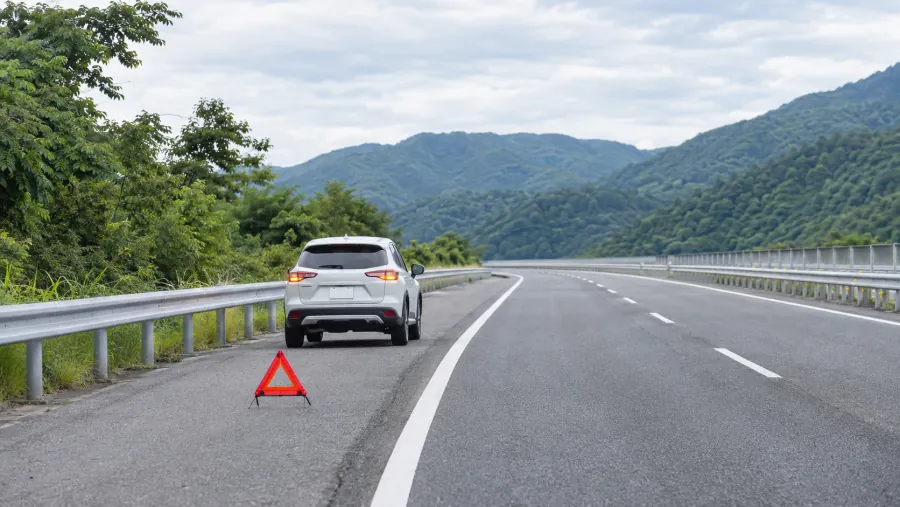
If your car breaks down on an expressway, pull onto the shoulder, warn traffic behind with hazard lights and a warning triangle, and get everyone, driver and passengers, behind the guardrail. Waiting inside the car is dangerous. There have been fatal accidents where a stopped car was hit from behind (source: NEXCO Central Drivers' Site). Once you are safe, call 110, use an emergency roadside phone or call the Road Emergency Line (#9910), and give the route name, your direction and the number on the nearest kilometer post.
Where should you stop if the car is about to fail?
If you notice something wrong, such as a strange engine noise or a warning light, turn on your hazard lights and pull onto a shoulder that is wide enough. Where the shoulder is narrow, such as on bridges or in tunnels, keep going to a wider spot while the car still moves (source: JAF Mate Online).
A car stopped in a traffic lane is hard to see from behind and much more likely to be hit. If it can move at all, get it out of the lane.
Once stopped, how do you warn traffic behind?
Use these three (NEXCO Central Drivers' Site).
- Turn on your hazard lights
- Light a flare
- Put out a warning triangle
On an expressway, putting out a warning triangle after a breakdown is a legal duty for the driver (Road Traffic Act, Article 75-11). Place it behind the car. JAF advises at least 50 m behind, as far as you safely can. Don't walk in the lanes to place it; go along the outside of the guardrail.
Why shouldn't you wait in the car?
A stopped car can be hit by traffic coming from behind. NEXCO Central says plainly that the inside of a car is not a safe place, and asks everyone, driver and passengers, to get behind the guardrail at a point behind the car.
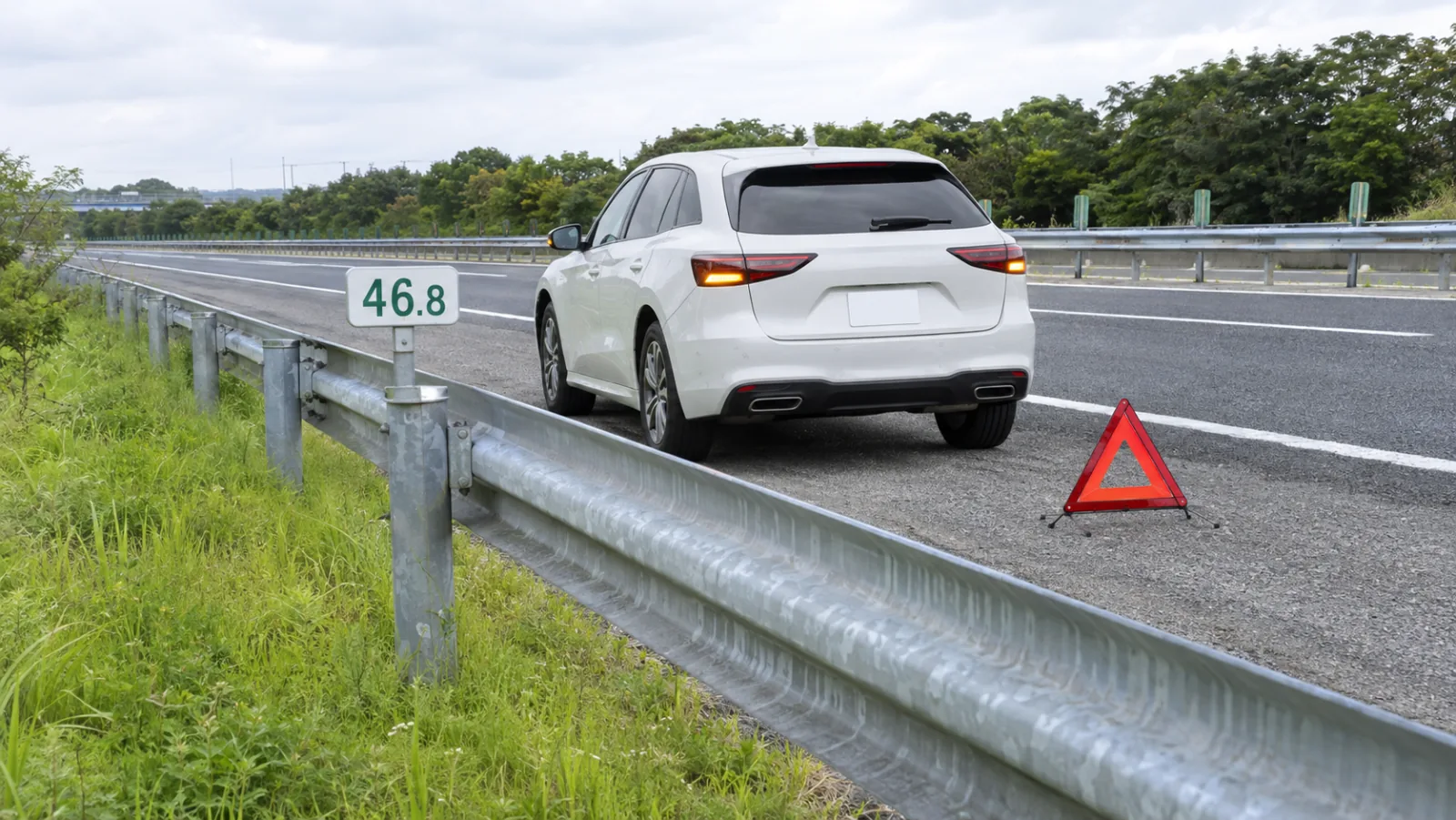
Standing behind the car keeps you out of the way if it is pushed forward in a collision. On a bridge or viaduct where you can't get past the guardrail, wait behind the car (JAF Mate Online).
Who should you call?
Once you are safe, report through 110, an emergency roadside phone or the Road Emergency Line (#9910). Do this even if you have already called a tow company yourself (NEXCO Central Drivers' Site).
| Contact | Best when |
|---|---|
| 110 | There has been an accident or someone is hurt |
| Emergency phone | One is nearby. Lifting the handset connects you to the traffic control centre |
| #9910 | Calling from a mobile. Free, 24 hours (source: MLIT) |
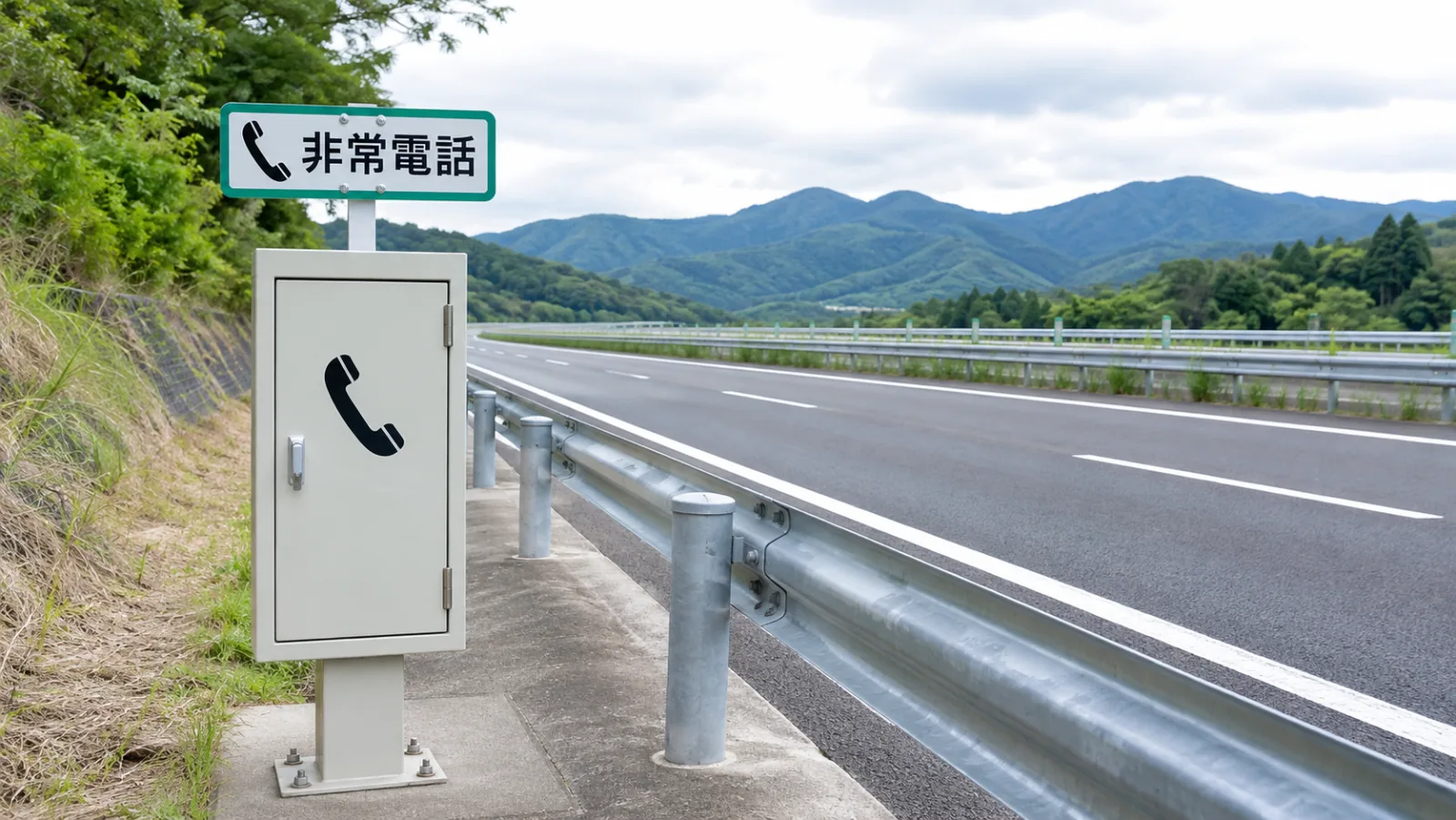
Emergency phones are placed every 1 km on the main line and every 200 m in tunnels, and lifting the handset tells the operator roughly where you are (source: NEXCO Central). Walk on the outside of the guardrail to reach one.
To get the car moved, ask for a tow separately, through the road service that comes with your car insurance or through JAF. If you call from an emergency phone, they can also pass on a request to JAF (JAF Mate Online).
How do you say where you are?
On an expressway, these three fix the spot. The Road Emergency Line (#9910) also asks callers to check the road name, direction of travel and kilometer post (MLIT). Give the same three to a road service.
| What to give | Example |
|---|---|
| Route name | Tohoku Expressway |
| Direction | Towards Sendai (outbound) |
| Kilometer post | Near kilometer post 46.8 |
Kilometer posts are small signs placed every 100 m on the shoulder or the central reservation. The number shows how far that point is from the start of the route, so "46.8" means 46.8 km from the start (source: NEXCO Central). From where you are waiting, there is always one within 50 m ahead or behind. You don't need to go closer; read it from behind the guardrail.
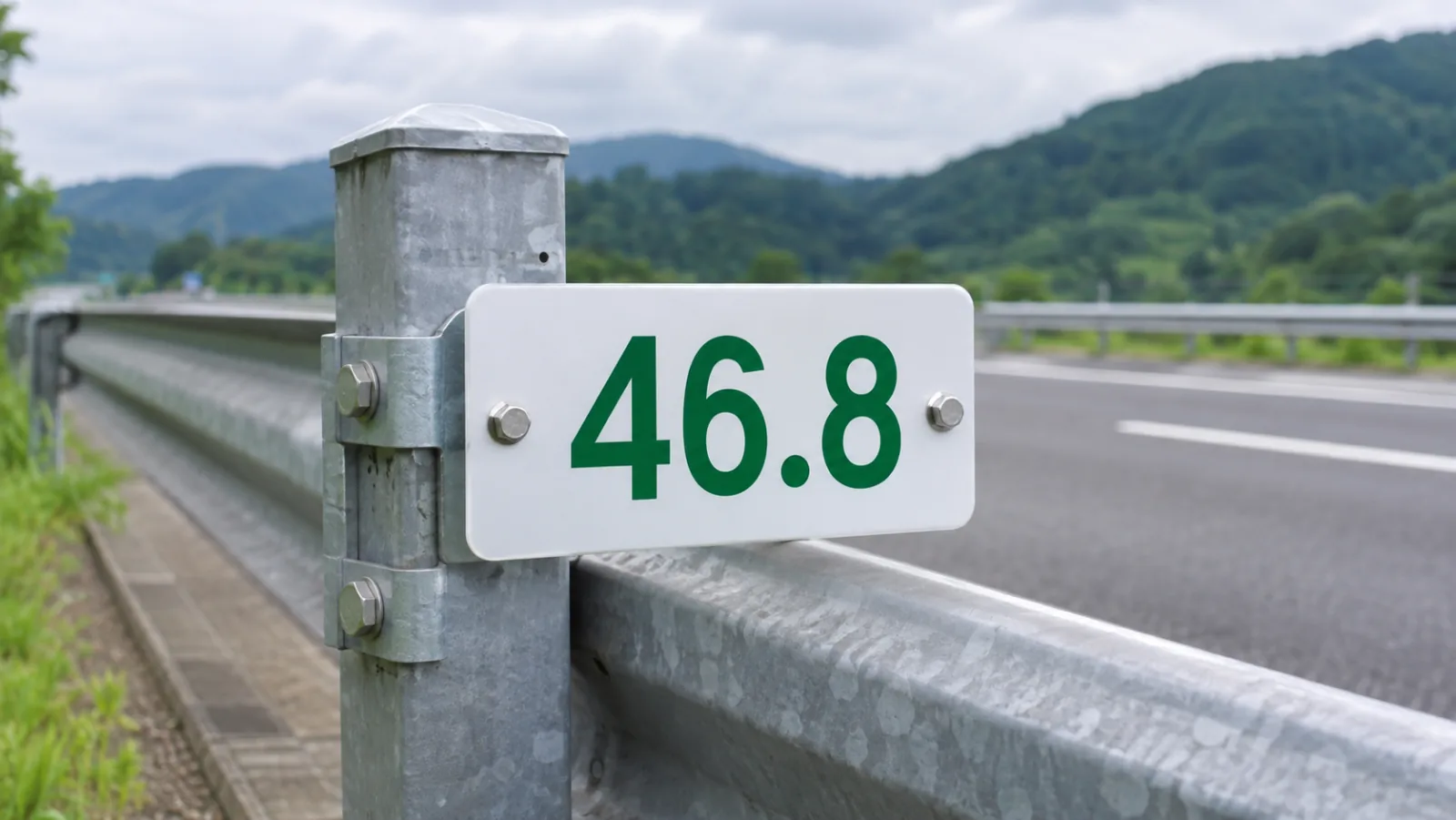
You need the direction because the numbers are the same on both carriageways (source: NEXCO East Drive Plaza). If you don't know whether you were on the inbound or outbound side, give the city or interchange you were heading towards. At night or on a bend where you can't see a post, give the last interchange, service area or parking area you passed, the name of a nearby tunnel or bridge, or your location in a map app.
What should you watch out for while you wait?
Wait behind the guardrail and stay off the shoulder and away from the car. NEXCO Central asks people not to walk around outside the car while they are evacuating or waiting. Don't go back to the car for your things.
Emergency phones are not available everywhere. Citing the spread of mobile phones, NEXCO East has been switching off emergency phones on some sections, except in tunnels and at rest areas, from 11 May 2026 (source: NEXCO East). If there is no emergency phone nearby, call #9910 or 110 from your mobile.
Read next What is an expressway kilometer post? And why both directions show the same number / Who do you contact when you find a hole in the road?
For using kilometer post locations as data Infra Intelligence's Kilometer Post Data gives the latitude and longitude of expressway kilometer posts as a CSV for each route, every 100 m.
Last checked: 9 November 2026
References (in Japanese)
- NEXCO Central Drivers' Site: "If an accident or breakdown happens"
- NEXCO Central Drivers' Site: "Emergency phones"
- JAF Mate Online: "What to do if trouble leaves your car unable to move on an expressway" (7 February 2025)
- MLIT: "Road Emergency Line (#9910)"
- NEXCO Central: "What are the roadside signs with numbers on them?"
- NEXCO East Drive Plaza: "What do the numbers on the expressway shoulder mean?"
- NEXCO East: "Ending operation of some expressway emergency phones" (27 April 2026)