How is pavement crack rate calculated? Counting cracks with a 50 cm grid
Pavement crack rate is found by dividing the road surface into 50 cm squares and counting area according to the number of cracks in each: 0.15 m² for one crack, 0.25 m² for two or more. This article explains the counting rules and the condition categories split at 20% and 40%, with a worked example.
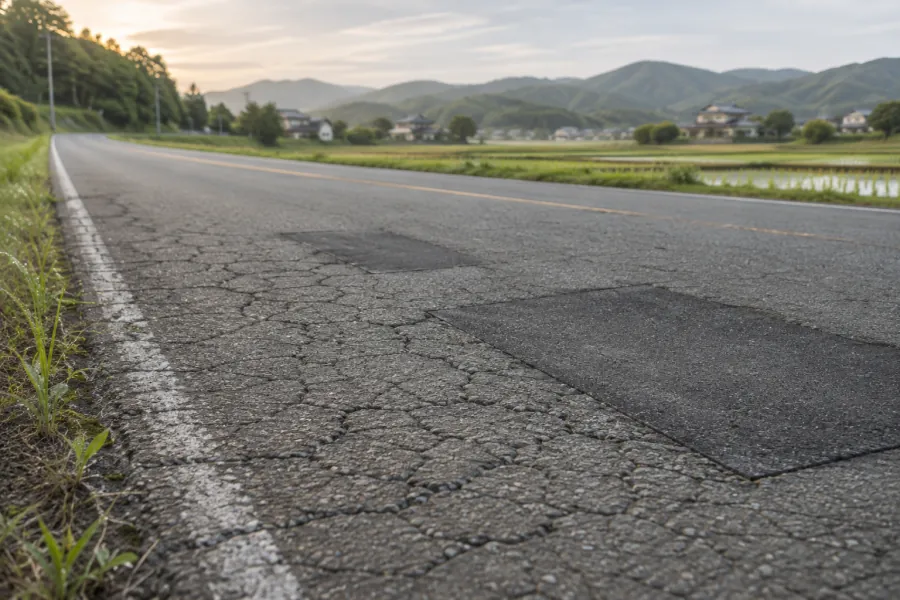
Pavement inspection results often include figures like "crack rate 25%". Japan's national Pavement Inspection Guidelines sort pavement into three condition categories depending on whether the crack rate exceeds 20% or 40%.
So how is that "25%" counted? This article explains how crack rate is calculated, with the counting rules and a worked example.
What is crack rate?
Crack rate is the share of the inspected road surface that is cracked, given as a percentage.
Crack rate = cracked area (m²) ÷ inspected area (m²) × 100
Cracks are thin lines, so the area of the lines themselves is not measured. Instead, the surface is divided into squares and the "squares with cracks" are counted by fixed rules.
How cracks are counted
According to the Ministry of Land, Infrastructure, Transport and Tourism (MLIT), a grid of 50 cm (0.5 m) squares is laid over the surface and each square is counted as follows (source: MLIT, "Evaluation Methods for Pavement Inspection Technologies, Reference 2"; originally the method in the Japan Road Association's Handbook of Pavement Investigation and Testing Methods).
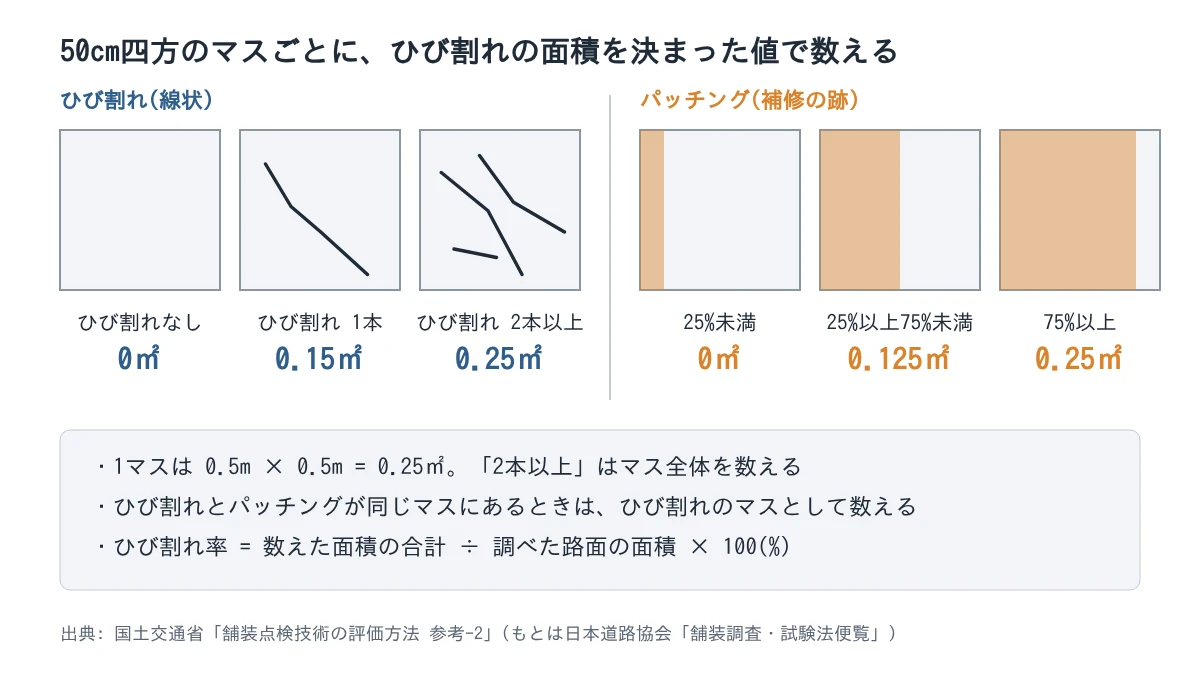
- One crack: counted as 0.15 m²
- Two or more cracks: counted as 0.25 m² (the whole square)
- Patching (marks where holes or cracks were repaired): 0 m² if under 25% of the square, 0.125 m² from 25% to under 75%, 0.25 m² at 75% or more
- If a square has both cracks and patching, it is counted as cracked
- Reinstatement after utility work and transitions around structures are not counted as patching
One square is 0.5 m × 0.5 m = 0.25 m², so "two or more cracks" means the whole square is treated as cracked.
A worked example
Say a lane 20 m long and 3.5 m wide is inspected. That is 40 squares along and 7 across, 280 squares in all, covering 70 m².
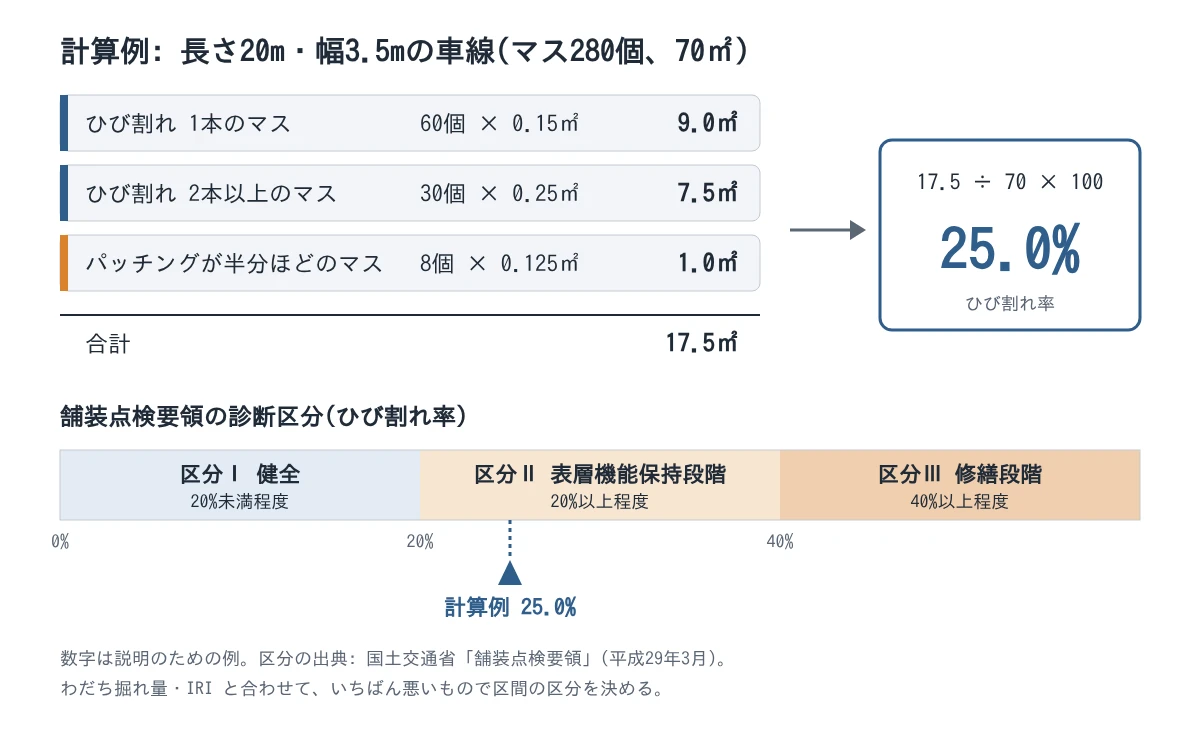
- Squares with one crack: 60 × 0.15 m² = 9.0 m²
- Squares with two or more cracks: 30 × 0.25 m² = 7.5 m²
- Squares about half covered by patching: 8 × 0.125 m² = 1.0 m²
- Total cracked area: 17.5 m²
- Crack rate: 17.5 ÷ 70 × 100 = 25.0%
(These numbers are an example for illustration.)
MLIT's material says this calculation is done for each 20 m section, and the category is decided by whether it exceeds 20% or 40% (source: MLIT, "Evaluation Methods for Pavement Inspection Technologies, Reference 2").
At what percentage is repair needed? The condition categories
The Pavement Inspection Guidelines sort asphalt pavement into three categories (source: MLIT, "Pavement Inspection Guidelines", March 2017).
| Category | Condition | Crack rate | Rut depth | IRI (roughness) |
|---|---|---|---|---|
| I | Sound | Under about 20% | Under about 20 mm | Under about 3 mm/m |
| II | Surface function maintenance stage | About 20% or more | About 20 mm or more | About 3 mm/m or more |
| III | Repair stage | About 40% or more | About 40 mm or more | About 8 mm/m or more |
The worst of the three indicators decides the category for the section. The 25.0% in the example above falls in Category II.
Road managers sometimes set finer thresholds of their own. Nagoya City, for example, splits Category III into 30 to under 40% and 40% or more (source: Nagoya City, "Optimal Maintenance Plan (Pavement)", March 2019). Check the plan for the roads you manage. What the categories mean is explained in "What are the Pavement Inspection Guidelines?".
How is it counted in practice?
The Pavement Inspection Guidelines make visual inspection (from a vehicle or on foot) the basis, with equipment used as needed (source: Pavement Inspection Guidelines).
- Road surface survey vehicles: dedicated vehicles that photograph the surface and read cracks from the images. On national roads, crack rate and rut depth are measured on a representative lane with these vehicles (source: MLIT, "Status Report on Drafting the Inspection Guidelines (Pavement)").
- Cameras or smartphones with AI: some technologies use AI to find cracks in video taken while driving. The national "Inspection Support Technology Performance Catalog" evaluates such technologies against values (ground truth) found with the method in this article. The catalog is covered in the article on the performance catalog.
Whatever the method, cracks are counted the same way. When using machines or AI, it is important to check that the results follow these counting rules.
FAQ
Q. What is the difference between crack rate and MCI?
MCI combines crack rate, rut depth and roughness into a single score out of 10 for pavement condition. Crack rate is one of the inputs to MCI. The Pavement Inspection Guidelines decide the category from each of the three indicators, not from MCI.
Q. Is concrete pavement counted the same way?
This article covers asphalt pavement. Concrete pavement is assessed on different points, so check the concrete pavement section of the Pavement Inspection Guidelines.
Q. Are the 50 cm squares actually drawn on the road?
When measuring on site by hand, a grid frame is laid on the surface and the squares are counted. When using images from survey vehicles or cameras, the grid is overlaid on the images.
To find pavement cracks with AI An app that finds road surface damage in dashcam video can be developed to your requirements. → AI-powered application development
Last checked: 16 November 2026
References (in Japanese)
- MLIT Road Bureau, "Pavement Inspection Guidelines", March 2017
- MLIT, "Evaluation Methods for Pavement Inspection Technologies, Reference 2" (how ground-truth crack rate is found)
- MLIT, "Status Report on Drafting the Inspection Guidelines (Pavement)"
- Nagoya City Green Space and Public Works Bureau, "Optimal Maintenance Plan (Pavement)", March 2019