How much can AI tell from road photos taken on a phone? Potholes, road signs, curve mirrors, and why wet asphalt gets mistaken for a pothole
From photos taken by a phone mounted in a car and facing forward, the AI models published in Model Lab can find the images that show potholes, road signs and curve mirrors. What they cannot tell apart, such as cracks or the exact type of sign, and why wet asphalt can be mistaken for a pothole.
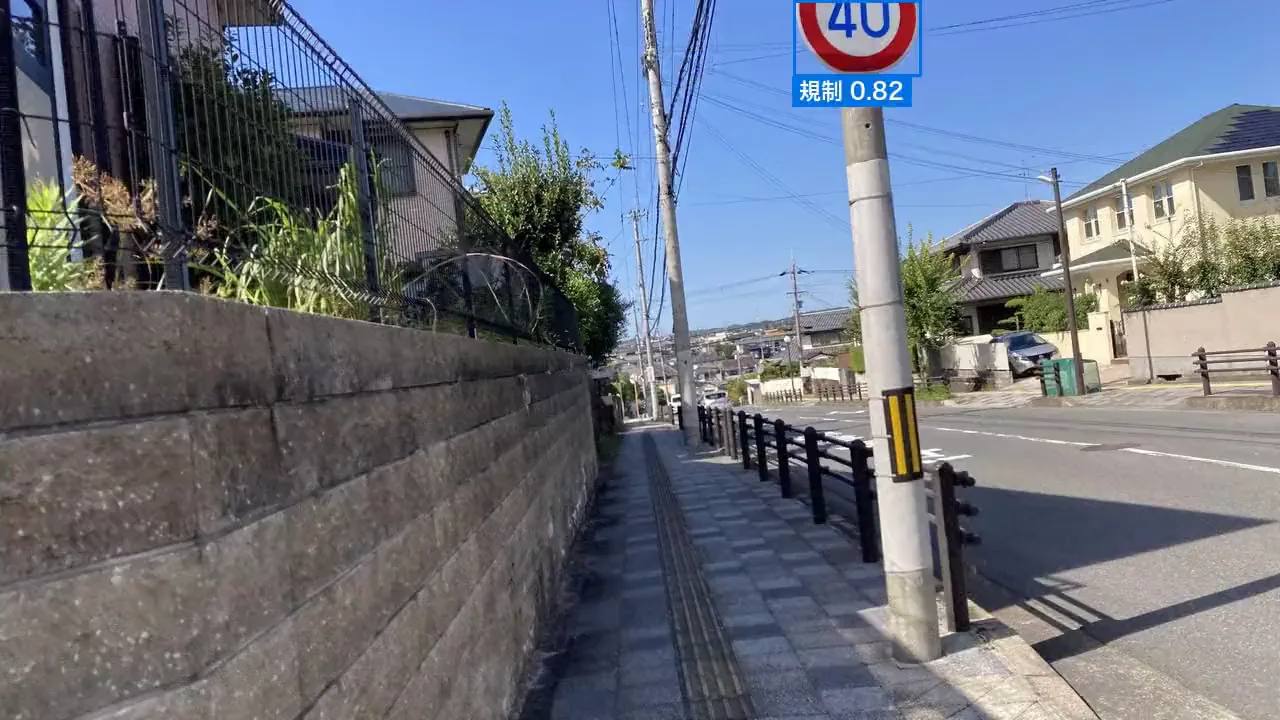
From road photos taken by a phone mounted in a car and facing forward, the AI models published in Infra Intelligence's Model Lab can find the images that show potholes, road signs and curve mirrors. They do not find cracks, though, and they do not tell a stop sign from a speed limit sign. They can also mistake dark, wet asphalt for a pothole, so always check the images the AI picks out with your own eyes at the end.
What kind of photos can the AI check?
Every Model Lab model is built for images taken while driving, by a phone or similar device mounted in a car and facing forward.
The road sign and curve mirror models take a landscape image (1280 × 736 pixels). Video shot with the phone held sideways (16:9) only needs resizing before it goes in. A 4:3 photo has to be shrunk further, and on the validation images more signs were missed (source: road-sign-yolox-tiny).
For each photo, the AI draws a box around what it found and adds a score (its confidence, from 0 to 1; the closer to 1, the surer it is). If you keep only the boxed images out of hundreds or thousands of photos, far fewer are left for a person to look through.
What does the pothole model find?
The pothole model returns the position of each pothole and a score. Anything scoring 0.45 or higher is treated as a pothole (source: Pothole RF-DETR Nano).
It finds potholes only. Cracks, including web-like cracking, and other damage get no box even when they are in the photo. Small potholes can be missed. How well it works at night, in rain or against the light has not been tested yet.
Why is wet asphalt mistaken for a pothole?
A photo shows the colour and shape of the road surface, but not the depth of a hole. The AI judges by appearance alone, so a dark wet patch can look like a pothole in colour and shape.
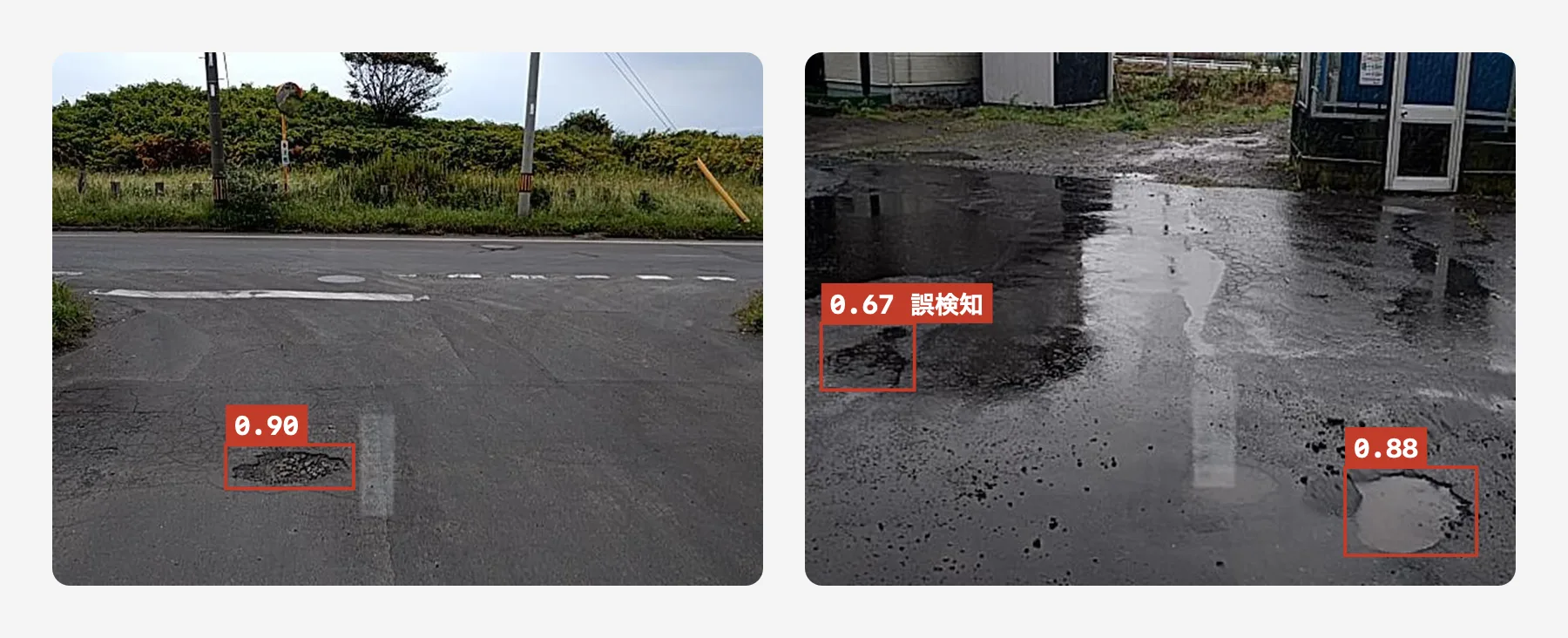
The right-hand photo above shows a road on a rainy day. When it was fed to the published model, the water-filled pothole at bottom right was found with 0.88, but the dark wet patch on the left was also judged a pothole with 0.67. Raising the threshold (the lowest score counted as a pothole) cuts this kind of false detection, but more real potholes are missed.
With photos from rainy days, zoom in and check that each box really is a pothole.
How far does the road sign model tell signs apart?
The road sign model finds signs and sorts them into five classes: guide, warning, regulatory, instruction and auxiliary. These five follow the classes set by law: road signs are main signs and auxiliary signs, and main signs are guide, warning, regulatory and instruction signs (Order on Road Signs, Lane Lines and Road Markings, Article 1).
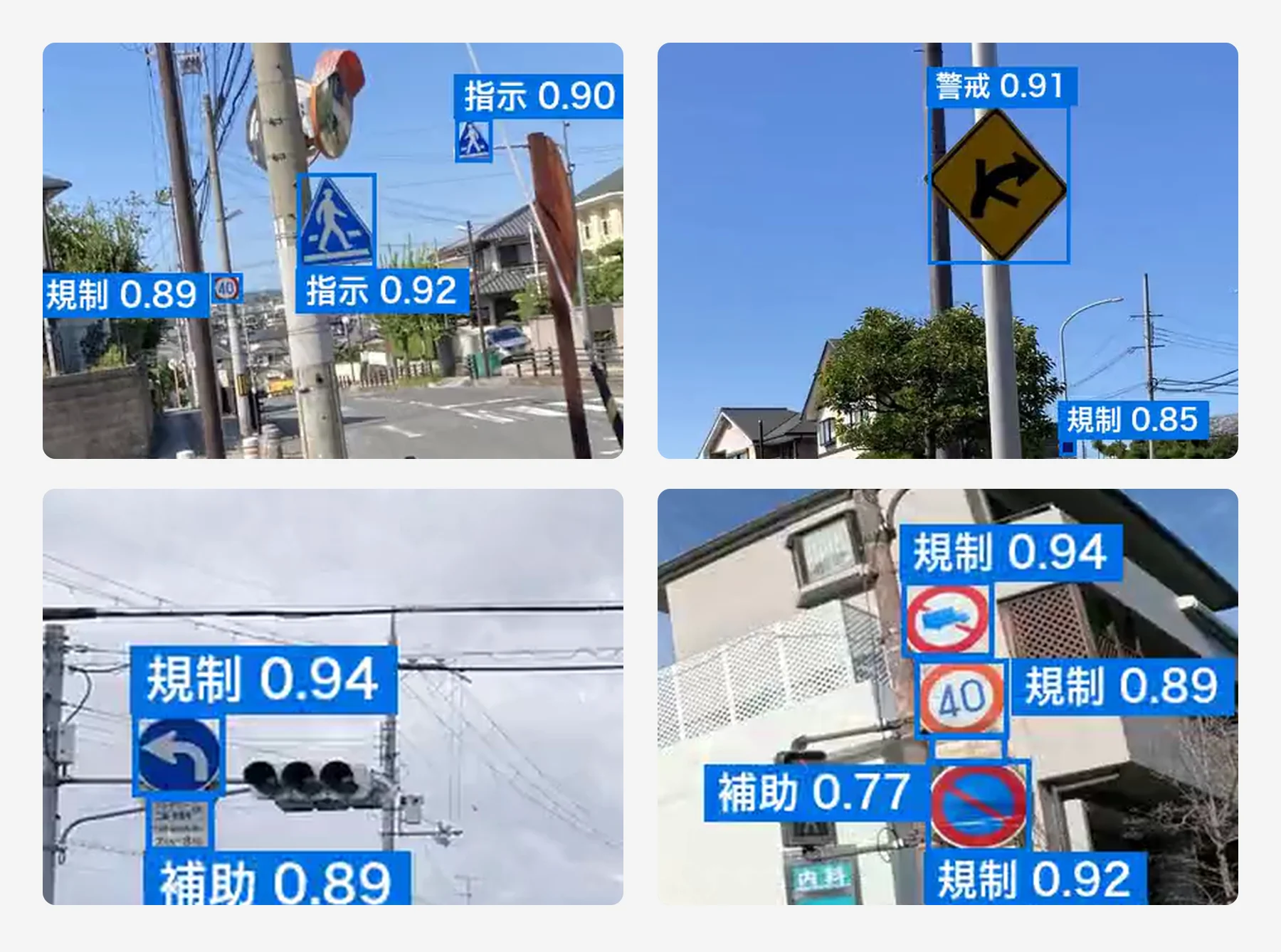
It does not separate a stop sign from a 40 km/h limit or a no-parking sign. All of them come out as "regulatory". When a main sign and an auxiliary sign share one pole, each plate is detected separately.
Guide signs, including intersection and street name signs, and auxiliary signs are missed more often than regulatory or instruction signs. Signs that appear large and close are also missed more often, and shop signs or address plates are sometimes taken for road signs.
How does the curve mirror model find mirrors?
A mirror on the dedicated orange pole is detected as one tall box covering both the mirror and the pole. A mirror fixed to a utility pole or elsewhere is detected by its mirror face only (source: curve-mirror-yolox-tiny).
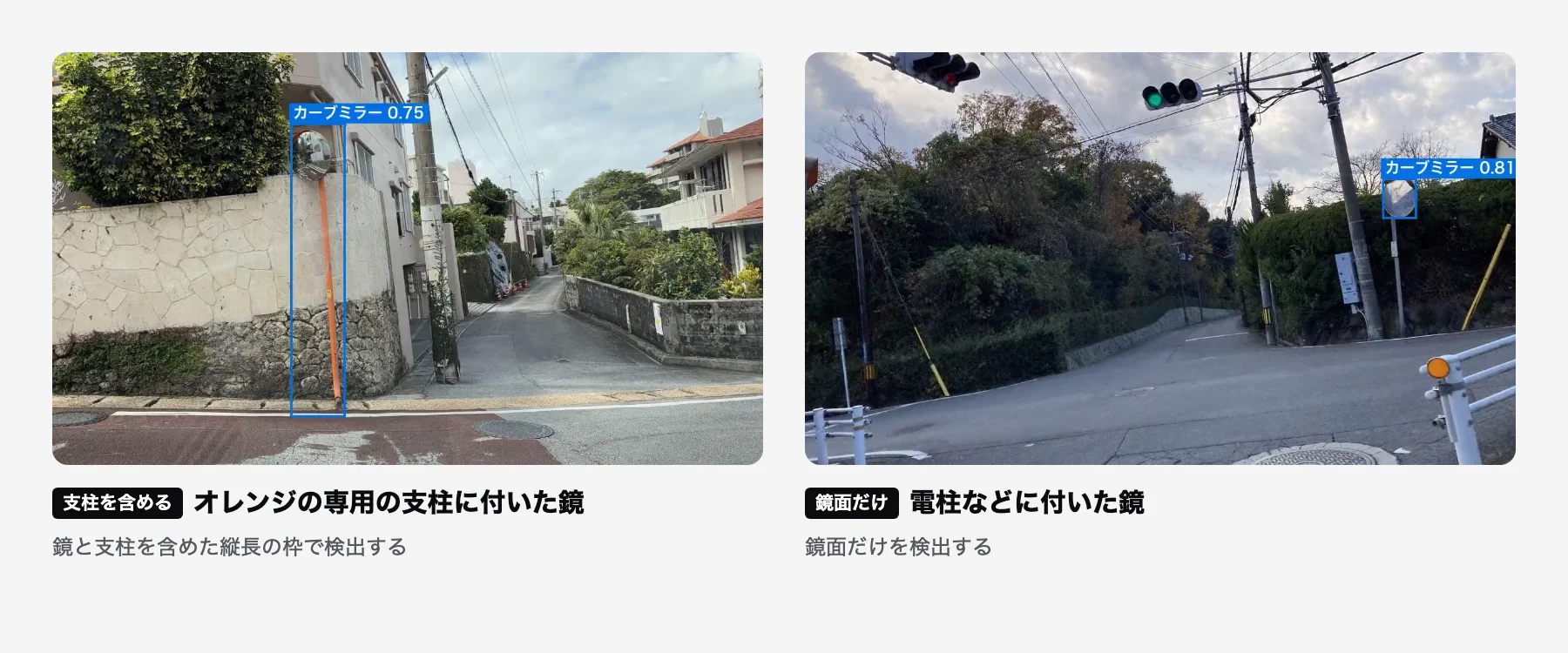
Mirrors without a dedicated pole in view are missed more often than those shown with their pole. Round signboards, round street-lamp shades and the backs of signs are sometimes taken for mirrors. The model does not judge whether a mirror is turned the wrong way or too dirty to reflect.
How does it tell the expressway snow-throwing signs apart?
Another model finds the "snow-throwing prohibition signs" on expressway shoulders, which mark where a section starts and ends in which snowplows must not throw snow. The start and end signs have the same colours and differ only in shape, and the AI tells them apart by that shape (source: snow-throw-sign-yolox-tiny).
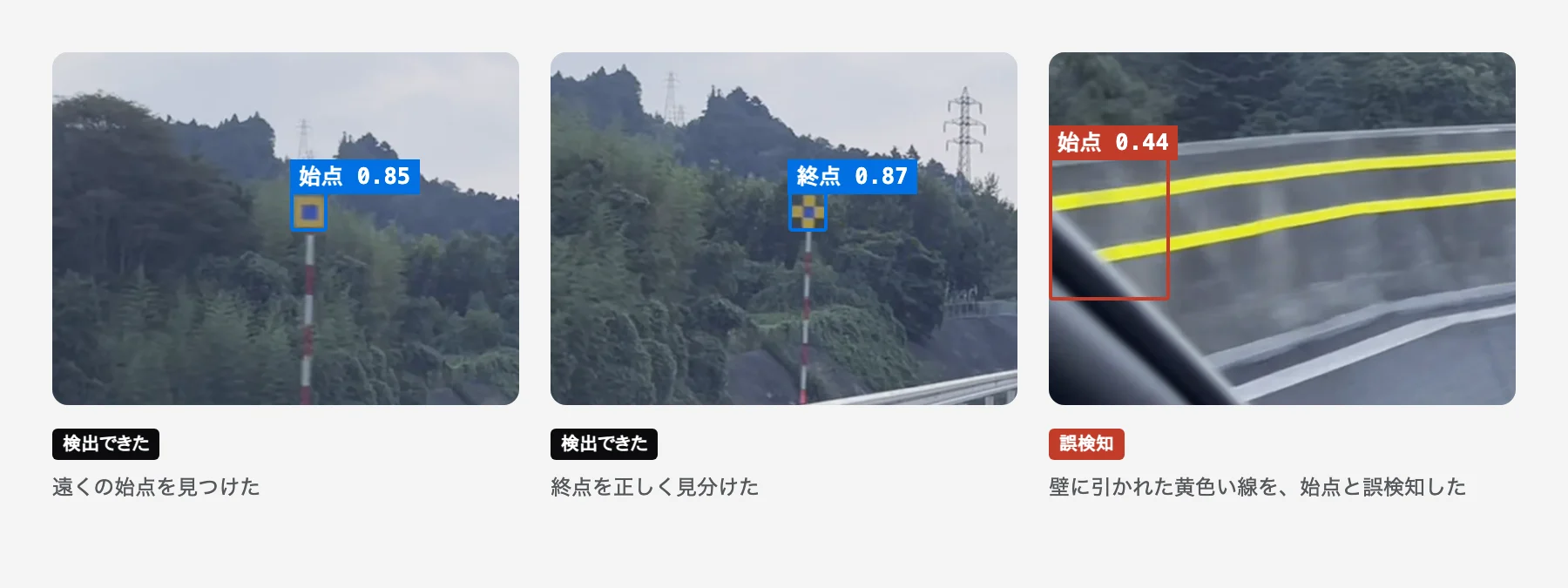
Tested on driving video used in neither training nor evaluation, it found even small, distant signs and told start from end correctly. On the other hand, it also mistook a yellow line painted on a wall for a start sign. Very little night footage was used in training.
Can the AI's results be used as they are?
No. Every model misses some objects and detects some that are not there, so do not make inspection or safety decisions from the AI's results alone. What it suits is picking out, ahead of time, the photos that show potholes or signs, so a person has fewer images to check.
To see whether it works on your roads, try photos taken with your usual phone, mounted the usual way. Feed in sunny, rainy and evening photos separately, and compare the AI's boxes with what you see yourself.
The inputs, outputs and evaluation results of each published model are in Model Lab.
Read next Detecting potholes with AI from a smartphone mounted in a car / Detecting road signs with AI and sorting them into five types
Want to build these models into a system? Apps that build in models like these to find road damage and roadside equipment in video are also developed on commission: AI-powered application development
Cover photo: 24kawa / Mapillary (CC BY-SA 4.0)
Last checked: 18 November 2026
References (in Japanese)
- Order on Road Signs, Lane Lines and Road Markings (e-Gov Law Search)
- infra-intelligence "Pothole RF-DETR Nano" on Hugging Face
- infra-intelligence "road-sign-yolox-tiny" on Hugging Face
- infra-intelligence "curve-mirror-yolox-tiny" on Hugging Face
- infra-intelligence "snow-throw-sign-yolox-tiny" on Hugging Face
- Arya et al., "RDD2022: A multi-national image dataset for automatic Road Damage Detection", arXiv:2209.08538